Software engineer mock interview
Updated
A software engineer mock interview on InterviewSparrow is a spoken interview with an AI interviewer, for software engineer and SDE roles from entry level to senior. It is built from your resume and the role you are aiming for, it includes a live technical exercise, and it is scored against InterviewSparrow’s engineering rubric. This page shows what that rubric listens for.
How the interview is set up
You add your resume and the role you are aiming for, and InterviewSparrow reads the role to decide which rubric the interview uses. A software engineering role — backend, frontend, SDE, SRE, DevOps and the like — gets the engineering rubric below.
You also choose the bar you are judged against: Entry-level (0–3 yrs), Professional (4–9 yrs) or Senior (10+ yrs). Questions and scoring are calibrated to the experience level you pick.
At the Entry-level bar the interviewer is told to favor fundamentals, guided problem-solving and evidence of potential over polish, and not to demand architecture-scale judgment or team-leadership stories. At the Senior bar it expects system-level judgment and hard trade-offs defended under pushback.
The live technical exercise
Every InterviewSparrow interview includes one hands-on exercise, and for an engineering role it is technical. You do not choose what kind: the interviewer goes by the role and level you set up. It runs a system design exercise for a staff or lead role, a coding exercise for a senior one, and for every other level a general technical exercise, where it asks you to sketch a diagram or write a snippet for one concrete technical problem rather than only describe it.
In a coding exercise the interviewer gives you one small, concrete problem and asks you to write the code or pseudocode while you talk through your approach, then probes data structures, edge cases and complexity as you go. In a system design exercise it poses a realistic design problem and asks you to diagram it as you speak — the components, the data flow, the request lifecycle — and pushes on bottlenecks, scaling, and consistency against availability.
Open your own tool before you share your screen — draw.io, Excalidraw, Figma, VS Code, CodeSandbox, Replit, or anything you prefer. InterviewSparrow does not include a built-in whiteboard or code editor.
You share your whole screen so the interviewer can follow what you write or draw. In a practice session nothing from your camera is recorded or sent, and your screen is not recorded as video; still snapshots of your on-screen work are kept until you delete them.
What the engineering rubric listens for
The interviewer and the report work from the same engineering rubric. It has six competencies, and for each one it lists things an interviewer can actually hear. Here is each competency with one strong and one weak signal from the rubric, lightly shortened:
- System design depth. Strong: names a specific scaling bottleneck (database write throughput, cache stampede, fan-out) and matches the solution to that exact bottleneck. Weak: lists technologies (Kafka, Redis, Kubernetes) without saying which problem each one solves in this design.
- Code clarity and maintainability. Strong: distinguishes code that runs from code that explains itself, and gives concrete habits for the second. Weak: defends clever one-liners or deeply nested abstractions on grounds of elegance.
- Debugging methodology. Strong: forms an explicit first hypothesis and names what evidence would falsify it before reaching for tools. Weak: jumps straight to a code change without naming the hypothesis being tested.
- Trade-off articulation. Strong: states a trade-off as “we lose X to gain Y”, with both named in concrete terms. Weak: uses “best practice” as a substitute for a reasoned trade-off.
- Cross-functional collaboration. Strong: names a time they pushed back on a product manager with a counter-proposal rather than a no, and what shipped. Weak: frames non-engineering teammates as obstacles without owning their part.
- Continuous learning. Strong: names something learned in the last month and how it changed a decision at work. Weak: names a stack untouched for two years as a current strength.
One of its questions, word for word
The rubric also gives the interviewer probe prompts for each competency. This one belongs to debugging methodology:
“Walk me through the last production bug you owned end-to-end. What was your first hypothesis and how did you validate it?”
When an answer shows one of the weak signals, the interviewer is told not to accept the abstraction: it follows up and asks for a quantified outcome, a specific example, or the trade-off you considered. It is also pointed at the responsibilities in the job description that your resume shows least evidence for.
If you are early in your career and have no production bug to your name, a bug from a university project or an internship answers the same question. What the rubric listens for is the hypothesis, not the size of the system.
What the report scores
After the interview you get a written report. It scores seven dimensions — content and relevance, structure and clarity, communication, behavioral signals, role-specific fit, consistency with your resume, and applied execution — each 1–5 against a fixed strong-performance bar (4.0), judged against the engineering rubric and every score tied to something you said.
Applied execution is the live exercise. When your shared screen could be read, it is scored mainly from the code or the diagram you produced; otherwise from how you worked through the problem out loud.
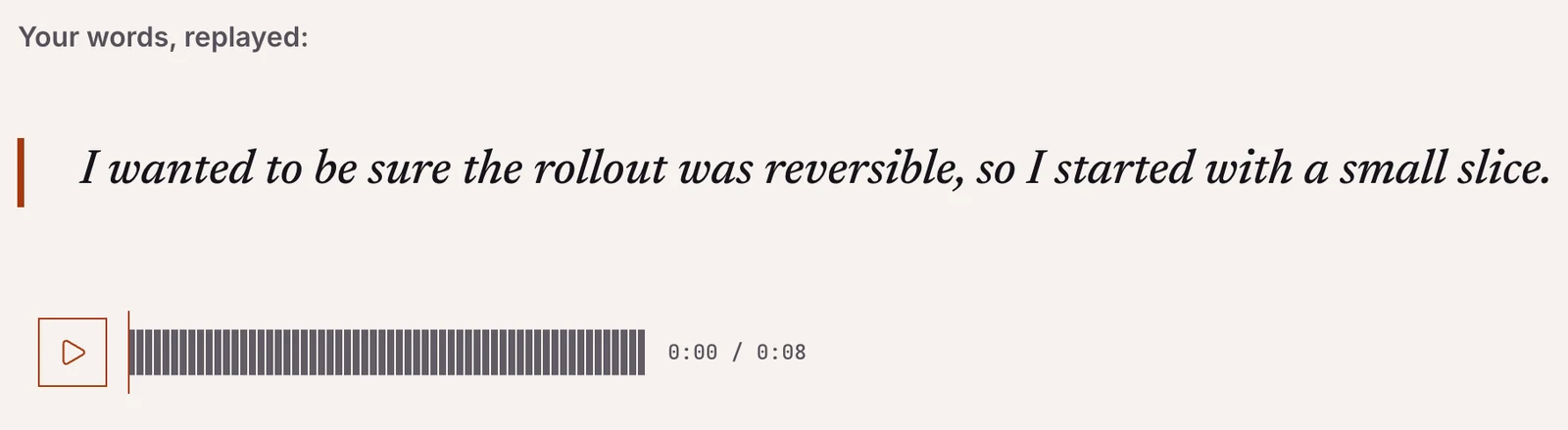
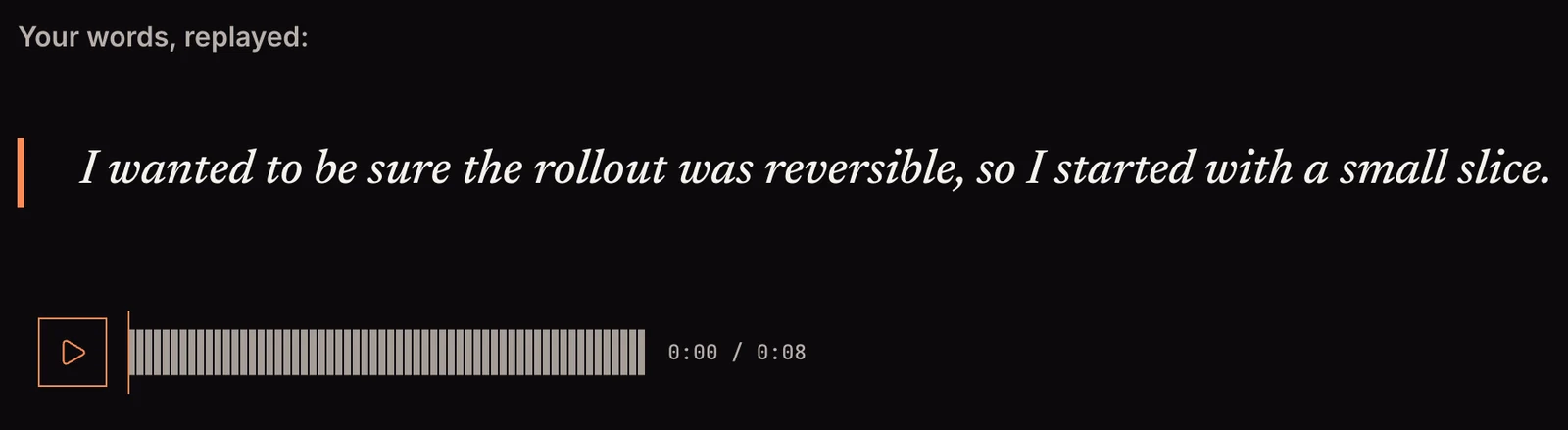
The report also ranks the three things to work on first, each drawn from your own answers, and plays back a Mirror Snippet: a short clip of one of your answers, fillers and pauses included.