Interview training you do out loud
Updated
Most interview training is something you read. InterviewSparrow is something you do: a spoken interview with an AI interviewer that you can get wrong safely, followed by an honest account of how you came across — repeated until the things you want to change have changed.
Preparation is not training
Most of what is sold as interview training is preparation: question banks, frameworks, lists of what to say. It is useful, and it is not training, because none of it asks you to perform. You can read every answer to "tell me about yourself" and still not have said yours out loud once.
Training is the other half — doing the thing, badly at first, with something honest telling you what happened. An interview is a spoken performance, and the habits that decide it, like how you open an answer, where you hedge, and what you do when you lose the thread, only appear while you are speaking to someone.
What a training round looks like here
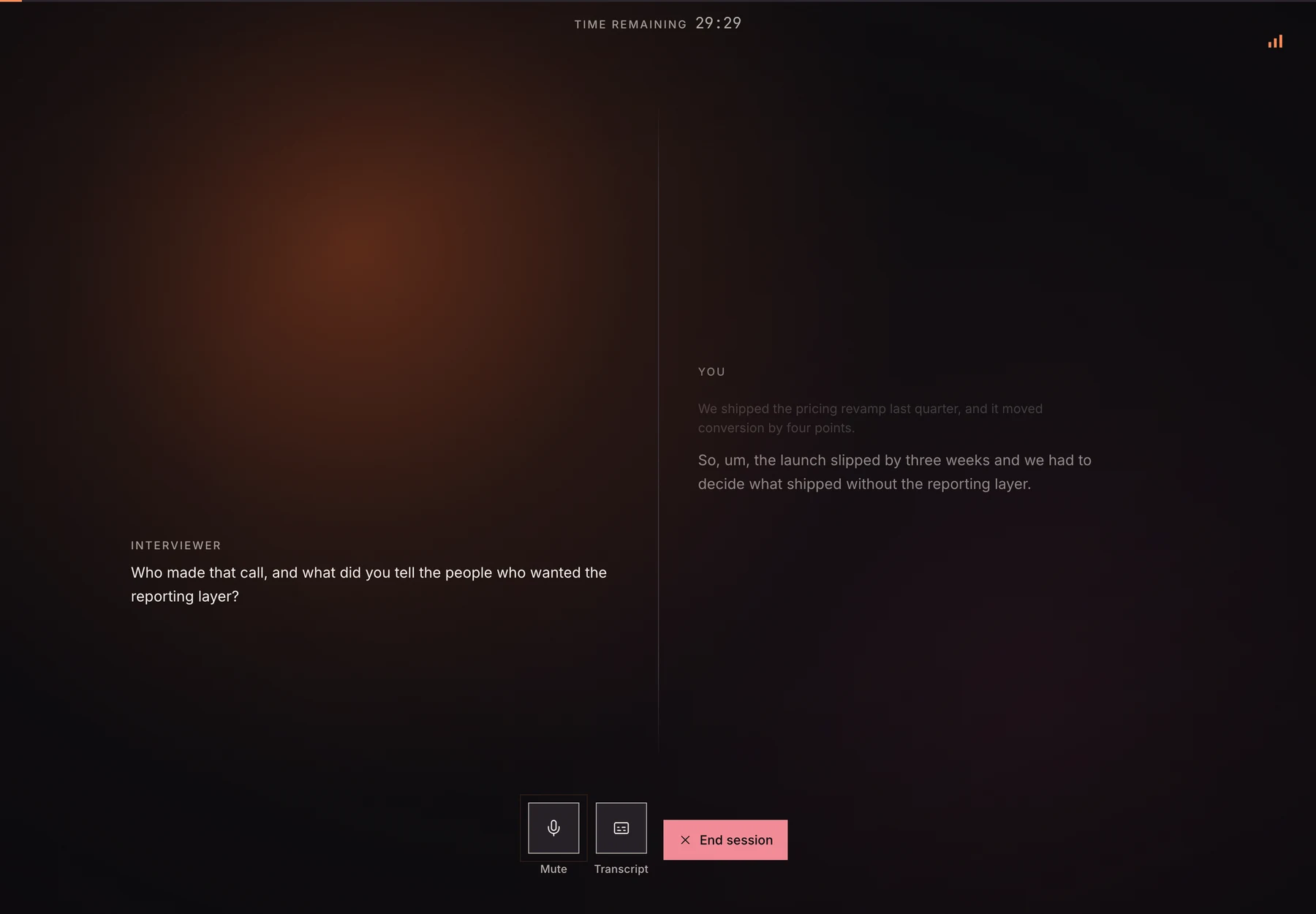
A round is one spoken interview, tailored to your resume and the role you are aiming for, with your screen shared and a live exercise in it. You talk. The AI interviewer listens, follows up, and pushes when an answer is thin.
Then it ends and you read what happened.
- You add your context first — your resume and the target role, so the questions are about your actual situation.
- You speak your answers in real time, with no script in front of you and no option to type.
- You get a report afterwards: seven scored dimensions, an honest verdict, and every point tied to something you said.
- You hear a Mirror Snippet — a clip of your own answer, fillers and pauses included.
What you can actually train
Not everything about an interview is trainable in a few rounds, and it is worth being clear about which half is which.
What moves quickly is delivery: how long you take to get to the point, how often you hedge, whether you answer the question that was asked, how you recover when you do not know. These are habits, they are visible in a transcript, and they change when you can hear them.
What does not move quickly is substance. No amount of rehearsal invents an experience you have not had. What practice does is stop a real experience from coming out as a shapeless story — which, often enough, is the whole gap.
Why repetition is the point
One round tells you where you are. It takes a few before you can tell whether something changed, because a single interview is noisy — a friendly question set or a bad morning moves a score more than a real improvement does.
Every session is scored against the rubric for your role, which is the part that makes repetition readable. The rubric for your role stays the same from session to session unless we revise it, so a move that holds across several rounds reflects you.
What it costs
You pay in credits, with no subscription and no course fee. Train as often as it’s worth training, and stop when it stops being worth it.
Common questions
No. There are no lessons, modules or videos — a session is a spoken interview and the report that follows it.
One session shows you where you are, and a few are usually needed before a change in the scores means something rather than noise.
It is different. A coach reads a room and negotiates with you; here the rubric for your role stays the same from session to session unless we revise it, so a move that holds across several rounds reflects you.
Yes. You give the role and your resume up front, and both the questions and the scoring follow the role and experience band you pick.