Engineering manager mock interview
By Shivangi Jain, Founder · Updated
An engineering manager mock interview on InterviewSparrow is a spoken interview with an AI interviewer, for engineering managers, heads and directors of engineering, and team leads who manage engineers. It is built from your resume and the role you are aiming for, it includes a live people or delivery scenario that you talk through, and it is scored against InterviewSparrow’s engineering management rubric. This page shows what that rubric listens for.
The interview itself runs on a laptop or desktop with your whole screen shared; everything else works on a phone or tablet too.
A 30-minute interview takes 10 credits.
How the interview is set up
You add your resume and the role you are aiming for, and InterviewSparrow reads the role to decide which rubric the interview uses. The engineering management rubric covers engineering managers, heads, directors and VPs of engineering, and team leads who manage engineers. A hands-on engineering role gets the engineering rubric instead, shown on the software engineer mock interview page.
The setup also asks for the interview bar: Entry-level (0–3 yrs), Professional (4–9 yrs) or Senior (10+ yrs). Questions and scoring are calibrated to the experience level you pick.
The live people scenario
Every InterviewSparrow interview includes one hands-on exercise, and for an engineering manager it is a spoken scenario about a team, its delivery or its people. The interviewer picks it from the role and level you set up and describes it in a few short sentences, and you talk it through, making the calls you would make on the job instead of recounting how you handled something before.
The rubric’s own live prompts show the range: a conversation with an engineer who has missed three commitments in a row, a choice between two finalists for one headcount, a re-plan after a senior engineer is pulled onto an outage, and a proposal to rewrite a core service. Hands-on coding is not part of it; that belongs to the engineering rubric.
The prep screen before the interview puts it this way: “Your exercise for this role is spoken: the interviewer describes a situation and you talk it through. You do not need to open any tool.” Your whole screen is still shared, as in every InterviewSparrow interview, but nothing on it is the work. In a practice session nothing from your camera is recorded or sent, and your screen is not recorded as video; still snapshots of it are kept until you delete them.
Engineering manager interviews test people management alongside technical skill. Worcester Polytechnic Institute’s Career Development Center groups the questions it lists for them under managing individuals, recruitment and hiring, management and team execution, and cross-functional communication, and the six competencies below run along the same lines.
What the engineering management rubric listens for
The interviewer and the report work from the same engineering management rubric. It has six competencies, and for each one it lists things an interviewer can actually hear. It judges a manager on what they did for the people and the outcome, and on technical judgment at the right altitude, not on how fast they could write the code.
Here is each competency with one strong and one weak signal from the rubric, lightly shortened:
- People leadership & coaching. Strong: describes how they run 1:1s — what goes on the agenda, who owns it, what they track between meetings. Weak: cannot recall a piece of hard feedback they gave in the last year, or describes every report as a high performer.
- Hiring & team building. Strong: describes the hiring bar in concrete terms and a time they held it against pressure to fill the seat. Weak: cannot say how long a new hire took to become productive or what they did to shorten it.
- Delivery & execution. Strong: uses a flow measure (cycle time, deployment frequency, change failure rate, review wait time) to find a bottleneck and says what they did about it. Weak: measures delivery by tickets closed or hours worked, with no outcome the team was aiming at.
- Stakeholder communication. Strong: escalates with a recommendation and two or three options rather than a problem statement alone. Weak: relays information without a point of view, so leadership has to work out what to do from the update.
- Technical judgment. Strong: argues for time on tech debt in terms the business accepts (incident rate, delivery speed) rather than as a matter of taste. Weak: describes incidents as who broke it rather than what the system allowed.
- Process & culture improvement. Strong: names a retrospective action that changed how the team worked and how they checked that it stuck. Weak: holds retrospectives that produce a list of actions nobody follows up.
One of its questions, word for word
The rubric also gives the interviewer probe prompts for each competency, and most of the sets include a live one. This one belongs to hiring and team building:
“Live: you have one headcount and two finalists — a strong senior who communicates poorly and a promising mid-level who is eager to grow. Talk me through your decision now.”
When an answer shows one of the weak signals, the interviewer is told not to accept the abstraction: it follows up and asks for a quantified outcome, a specific example, or the trade-off you considered. A strong answer here states the hiring bar in concrete terms, as the first strong signal for hiring does, and names what it gives up by choosing one finalist.
If you are moving into management for the first time, a team you led informally or a project you ran can answer the same questions.
What the report scores
After the interview you get a written report. It scores seven dimensions — content and relevance, structure and clarity, communication, behavioral signals, role-specific fit, consistency with your resume, and applied execution — each 1–5, judged against the engineering management rubric and every score tied to something you said.
Applied execution is the live exercise: how you worked through the scenario, judged against the rubric’s competencies for your role.
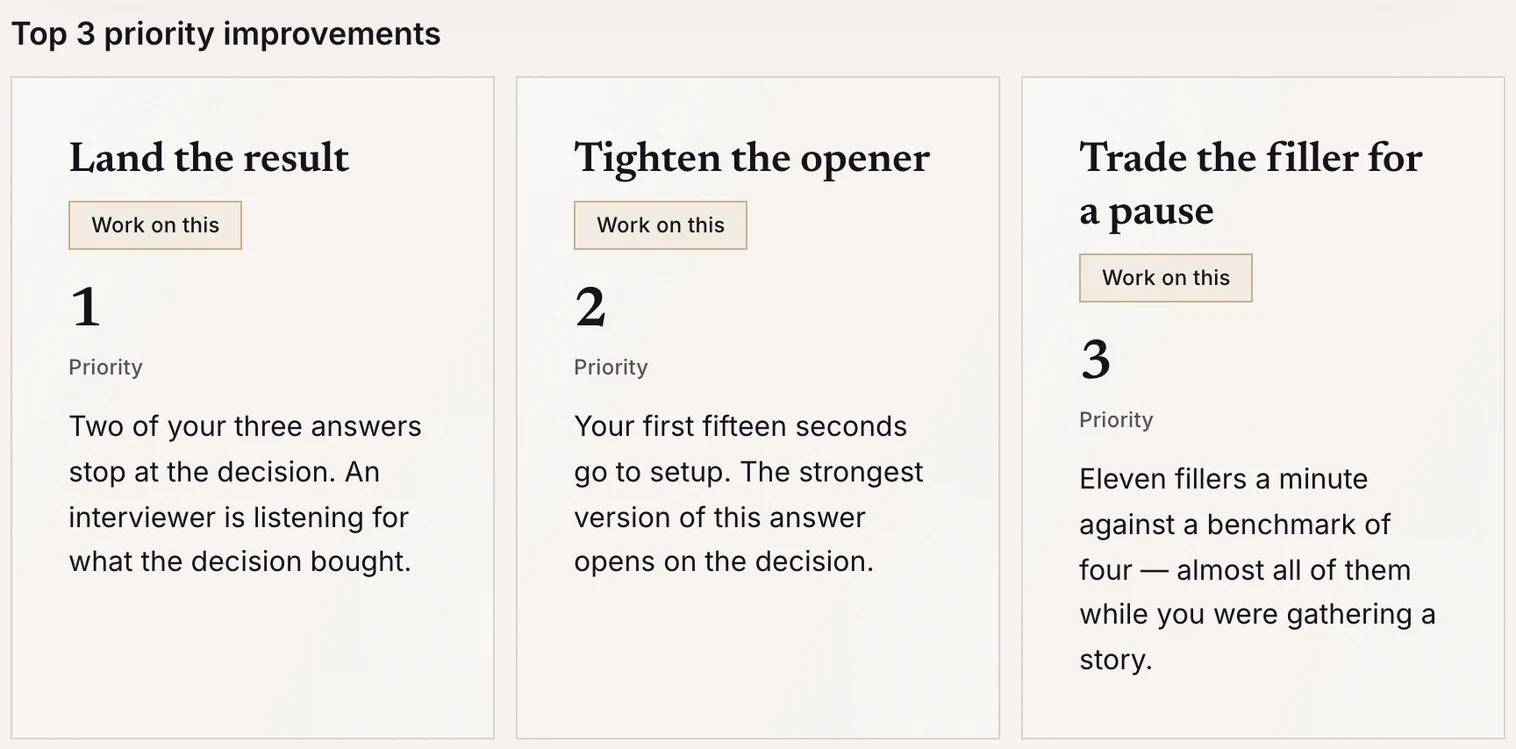
The report also ranks the three things to work on first, each drawn from your own answers, and plays back a Mirror Snippet: a short clip of one of your answers, fillers and pauses included.
Common questions
An engineering manager mock interview on InterviewSparrow covers six competencies: people leadership and coaching, hiring and team building, delivery and execution, stakeholder communication, technical judgment, and process and culture improvement.
The engineering management rubric leaves hands-on coding to the engineering rubric; its exercise is a spoken team, delivery or people scenario that you talk through, with no tool to open.
InterviewSparrow scores an engineering manager mock interview on seven dimensions, each 1–5 and tied to something you said, and ranks the three things to work on first.