How to answer “Tell me about yourself” as a new graduate
Updated
“Tell me about yourself” is one of the most common ways an interview begins, and InterviewSparrow’s AI interviewer opens the same way. For a new graduate it is the one question you can prepare completely: nobody expects a long career, only a clear picture of who you are, what you have done and why this role. Here is what the question is really testing, a structure that works, and three example answers.
Why the interview starts here
InterviewSparrow’s interviewer starts with a short greeting and a light question, then invites you to introduce yourself in your own words — a sentence or two about who you are and what you do — with at most one easy follow-up. On a full-length session that warm-up takes about one to two minutes.
The interviewer is told to let you talk here, because the opening is a natural sample of how you communicate. Then it moves into the interview by picking up something specific from your resume: a company, a project, a number or a responsibility. So anything on your resume, and anything you mention, is fair game for the next question.
What the question is really testing
It is not a request for your life story. An interviewer is listening for whether you can pick the few things that matter and say them clearly. InterviewSparrow’s general interview rubric, the one used when a role fits no specific family, names what it listens for, and four of its competencies apply directly to an introduction:
- Concrete examples over abstractions. Strong: reaching for a specific moment — a project, a date, a person — rather than a generalization. Weak: “I always make sure to…” with no time it actually happened.
- Structured answers. Strong: setting the scene briefly, naming the action you took yourself, and closing on an observable result. Weak: a story that trails off without an outcome.
- Communication clarity and pacing. Strong: pitching the detail at the listener’s level, and cutting an answer short when they want to move on. Weak: jargon or acronyms with no explanation.
- Quantified outcomes. Strong: a number where one exists, with what it was measured against, and a clean “I don’t have the number” when it does not. Weak: “significantly” or “a lot” with nothing behind it, or a number made up under pressure.
What a new graduate is expected to show
Before an InterviewSparrow interview you choose the bar you are judged against, and Entry-level covers 0–3 years of experience. At that bar the interviewer is told to favor fundamentals, guided problem-solving and evidence of potential over polish, and not to demand architecture-scale judgment or team-leadership stories.
That is a fair description of what most interviewers want from a new graduate’s introduction too: not achievements you do not have yet, but a clear sense of what you have actually done and how you think about it.
One of the seven dimensions in an InterviewSparrow report is consistency with your resume, so the safest introduction is one your resume backs up.
A three-part structure
There is no single correct answer, and a memorized script works against you: the same rubric lists an answer recited “so rigidly it sounds like a script” as a weak signal. A structure only helps if you can say it naturally. This one works for most new graduates:
- Now: who you are, in one sentence — your degree, your subject, your university or college and the year you finish.
- Proof: one thing you have done that shows what this role needs — a project, an internship, a competition or a responsibility — with one detail only someone who did it would know, and a number if you have one.
- Next: why this role, tied to that proof, in one sentence.
How long it should be
Shorter than most people expect. InterviewSparrow’s interviewer asks for a sentence or two and follows up when it wants more, so practice the short version first. When an interviewer gives you more room, keep the same three parts and spend the extra time on the proof, not on your background.
Three example answers
These show the structure; they are not scripts to learn. The people are invented for this guide, and so are their colleges, projects and numbers. Say your own.
Example 1, a final-year computer science student (invented): “I’m Lena, and I finish my computer science degree this year. The project I’m proudest of is a room-booking app three of us built for our student residence. I wrote the booking logic, and when two students could book the same slot I traced it to two writes racing each other and fixed it with a unique constraint. About 200 students used it last semester. I’m applying for backend roles because that bug was the most interesting week of the project.”
Example 2, a business graduate (invented): “I’m Daniel. I finished my business degree last year, and for six months I’ve been an accounts intern at a small trading firm, reconciling vendor payments in QuickBooks every week. I once found the same invoice paid twice in two different months, and since then I check the ledger against the bank statement before closing each week. I’m applying for this analyst role because I want to do that kind of checking with more data.”
Example 3, a final-year student with no internship yet (invented): “I’m Sana, and I graduate in electronic engineering this year. I haven’t done an internship, so the closest thing I have to real work is our final-year project, a soil-moisture sensor that switches on a pump for the college garden. The first version flooded the bed because I had the threshold the wrong way round, and that taught me to test my assumptions before a demo. I’m applying for this support engineer role because I like finding out why something doesn’t work.”
What to leave out
Five things that make an introduction weaker, not stronger:
- Your resume, read aloud line by line. The interviewer already has it.
- Personal details such as your date of birth, marital status or family background, unless you are asked.
- Adjectives with nothing behind them — “hard-working”, “passionate”, “a quick learner”. The rubric hears a generalization with no example as a weak signal.
- Anything your resume cannot back up. The next question may be about it, and consistency with your resume is scored.
- A memorized paragraph. If you lose your place in it, you lose the thread of the whole answer.
Practice it out loud
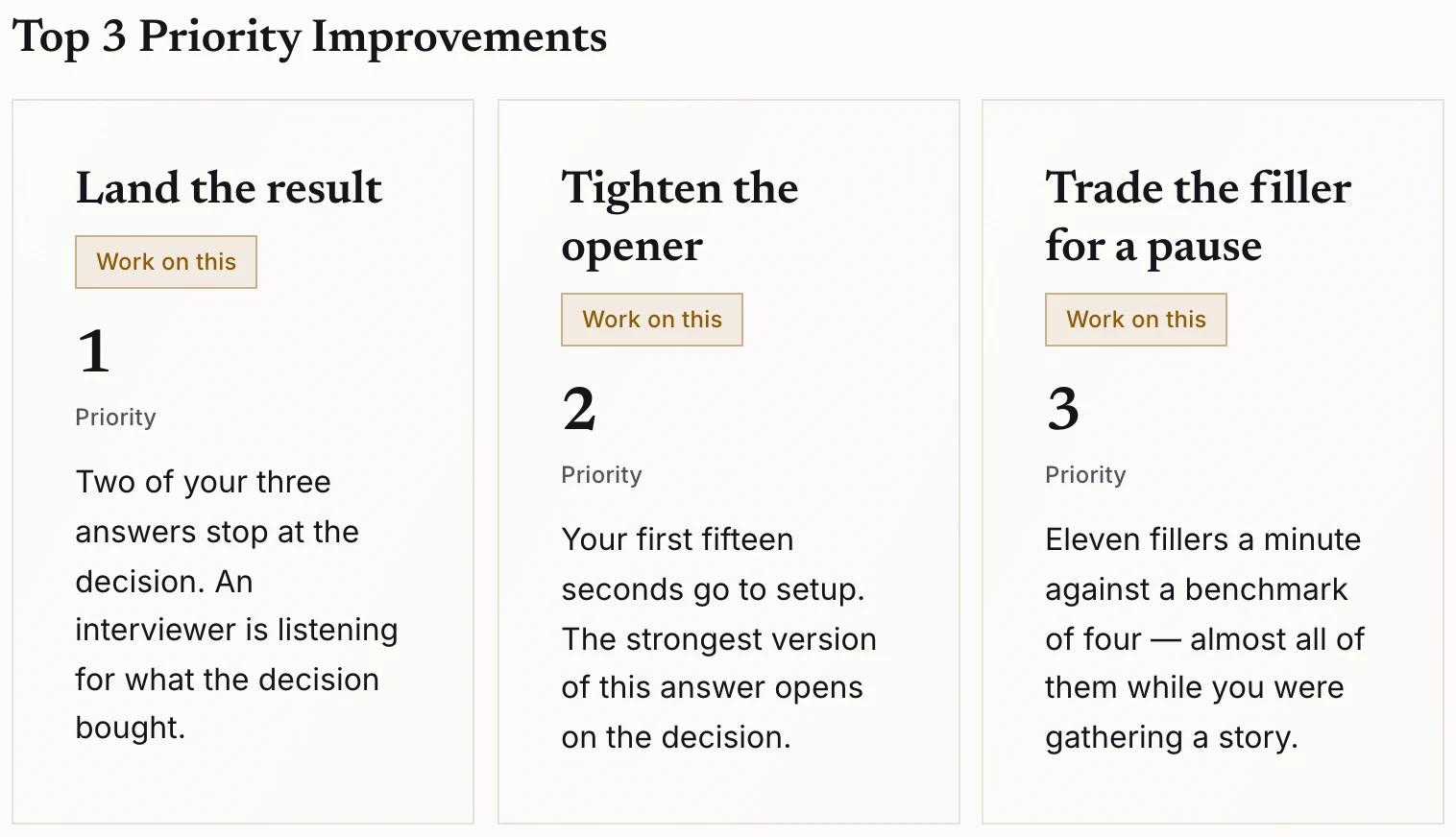
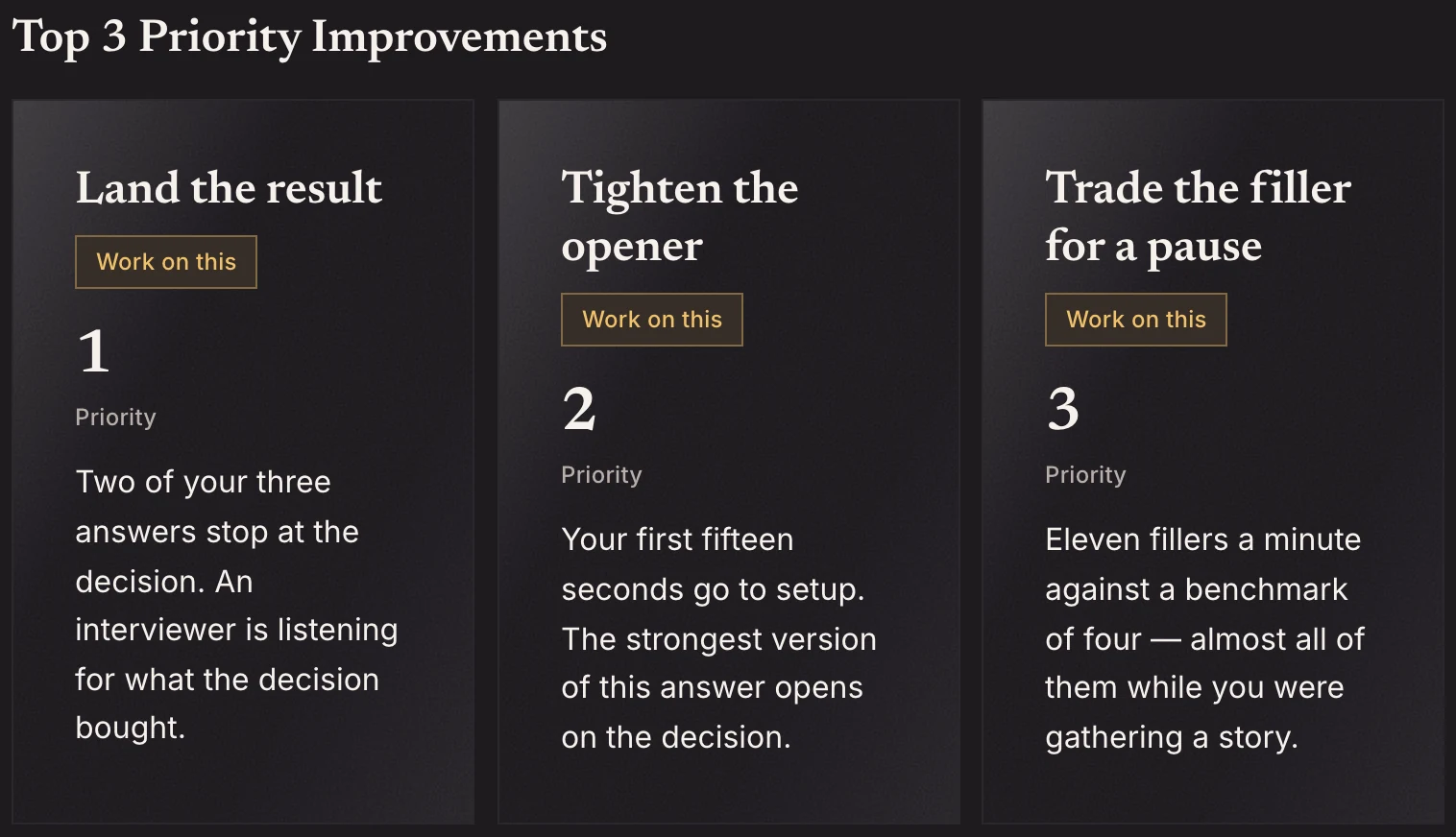
Reading this guide will not tell you how your answer sounds. Saying it out loud to an interviewer that follows up will. After an InterviewSparrow session the report ranks the three things to work on first, each drawn from your own answers — like the sample below, where an answer spent its first fifteen seconds on setup.
If you are preparing for an engineering role, the software engineer mock interview page shows what the interviewer listens for once the introduction is over. For any other role, start with how mock interview practice works.