How to interview after changing careers
By Shivangi Jain, Founder · Updated
Interviewing after a career change comes down to one job: showing the interviewer what you already do that this role needs, and why you want it. Hiring managers do not expect you to match every line of the job description, but they do want to understand why this move and why this employer. Here is how to find your transferable skills, answer “Why are you changing careers?”, introduce yourself, and practice the whole thing out loud.
The interview itself runs on a laptop or desktop with your whole screen shared; everything else works on a phone or tablet too.
A 30-minute interview takes 10 credits.
What counts as a transferable skill?
A transferable skill is something you already do well that the new job also needs, and you can show it with something you did. Communication, problem-solving, leadership and adaptability are the usual examples, and the useful part is the proof: a project, a result or a moment in your earlier work where you used the skill.
Boston University’s Center for Career Development names the same four and advises career changers to emphasize how such skills were honed in past roles and to quantify achievements where they can. Start from the job description and match it to your own work:
- Copy the five or six requirements the job description repeats.
- Next to each one, write something you did that shows it: a project, a decision, a result.
- Mark the requirements with no match. Those are the questions to prepare for, not to hide.
How do you explain why you are changing careers?
Expect the question in some form. The University of Pennsylvania’s Career Services describes what hiring managers want to understand as why you are making this move, why now and why their company, and advises showing what you are bringing with you rather than dwelling on what you are leaving behind.
An answer that works has three short parts, in this order:
- What carries over: one or two skills from your earlier work, each with its proof.
- What you have done to prepare for the new field: a course, a project, or a tool you learned.
- Why this role: one sentence that ties the first two parts to what the job needs.
What does a “Tell me about yourself” answer sound like for a career changer?
This shows the structure; it is not a script to learn. The person is invented for this guide, and so are the store, the course and the numbers. Say your own.
Example, a career changer (invented): “I’m Omar. I managed a bookstore for eight years, and I’m moving into operations. What carries over is planning around fixed dates: I scheduled twelve staff across a holiday season, and I rebuilt our stock-count routine so a full count took two evenings instead of four. I’ve also finished an evening course in spreadsheet modeling, and I used it to build the ordering plan we run today. I’m applying for this operations analyst role because I like making a routine quicker for everyone who depends on it.”
Notice what it leaves out: no apology for the old field and no list of everything the job asks for. It names two skills, gives proof for each, and ends on why this role.
What do interviewers worry about with a career changer?
Interviewers often ask about adaptability, willingness to learn and commitment to the new path. Boston University’s career center suggests answering with occasions when you adapted to a new challenge or picked up a new skill, and with a genuine interest in the industry and the role.
Prepare one story for each: a time you learned something quickly and what you did to learn it, and a reason, specific to this field, that you want to stay in it.
How do you practice it out loud?
Reading an answer does not show how it sounds. Say it out loud to someone who asks follow-up questions: Boston University’s career center recommends mock interviews with friends, family or career advisors, with feedback on your responses, because repetition builds confidence.
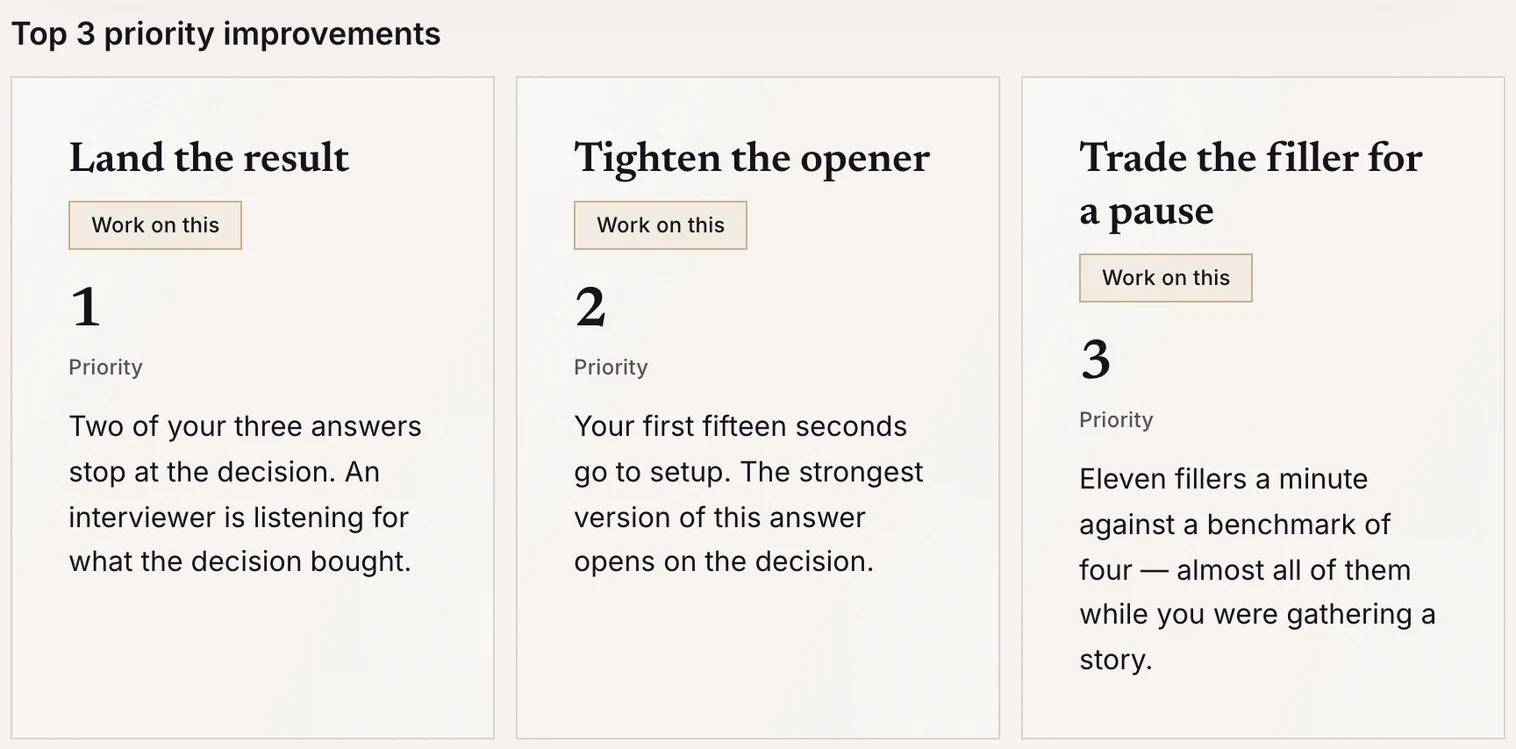
An InterviewSparrow mock interview is one way to do that whenever you are ready. You add your resume and the job description of the new role, so the questions are about that job, and the AI interviewer follows up on what you say, as a hiring manager would. The report scores seven dimensions, each tied to what you said, ranks the three things to work on first, and plays back a Mirror Snippet of one of your own answers. A loop that works:
- Run an interview built from the new role’s job description.
- Read which of your answers named proof and which only named a skill.
- Rewrite the weakest answer, say it a few times, and run the next interview.
Common questions
A career change is best explained in three short parts: the skills from your earlier work that this role needs, with the proof; what you have done to prepare for the new field; and why this role. Spend your time on what you bring to the job, not on the one you are leaving.
Skills that transfer include communication, problem-solving, leadership and adaptability, but an interviewer wants proof, so name a project or a result from your earlier work that shows each one.
A mock interview helps a career changer by letting you say your answer out loud, against the job description of the new role, to an interviewer that follows up on what you said.