Skip to content

A sample AI mock interview report

This is what comes back about three minutes after an InterviewSparrow interview ends: five sections, every judgement tied to something the candidate said. The candidate here is synthetic.

Real screenshots of the product, running a sample session — not a real candidate

A. Overall verdict
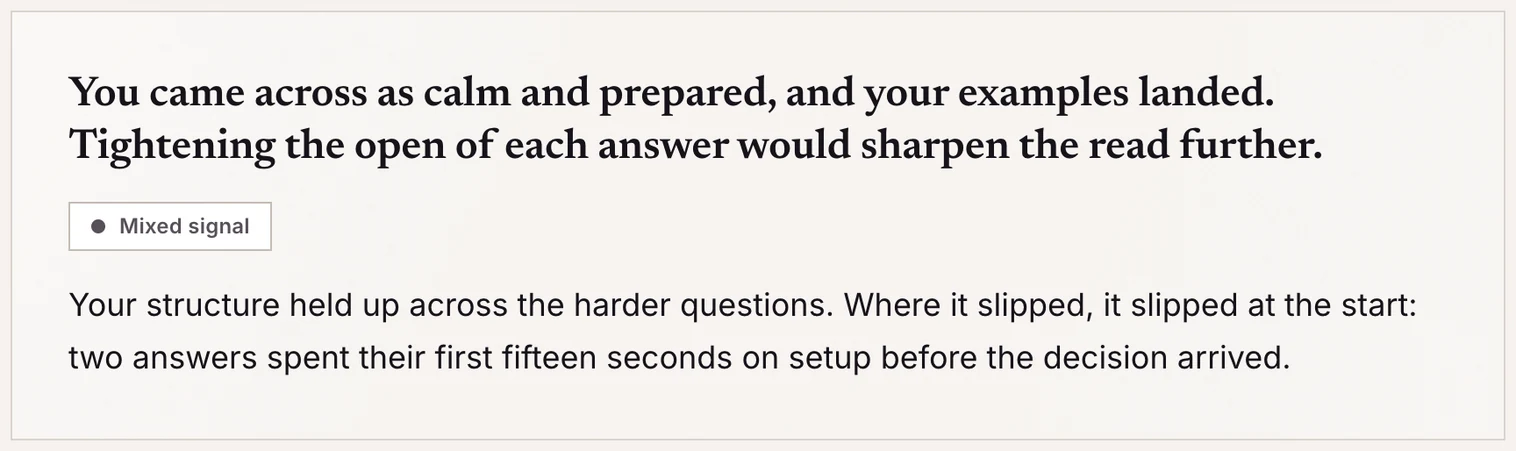
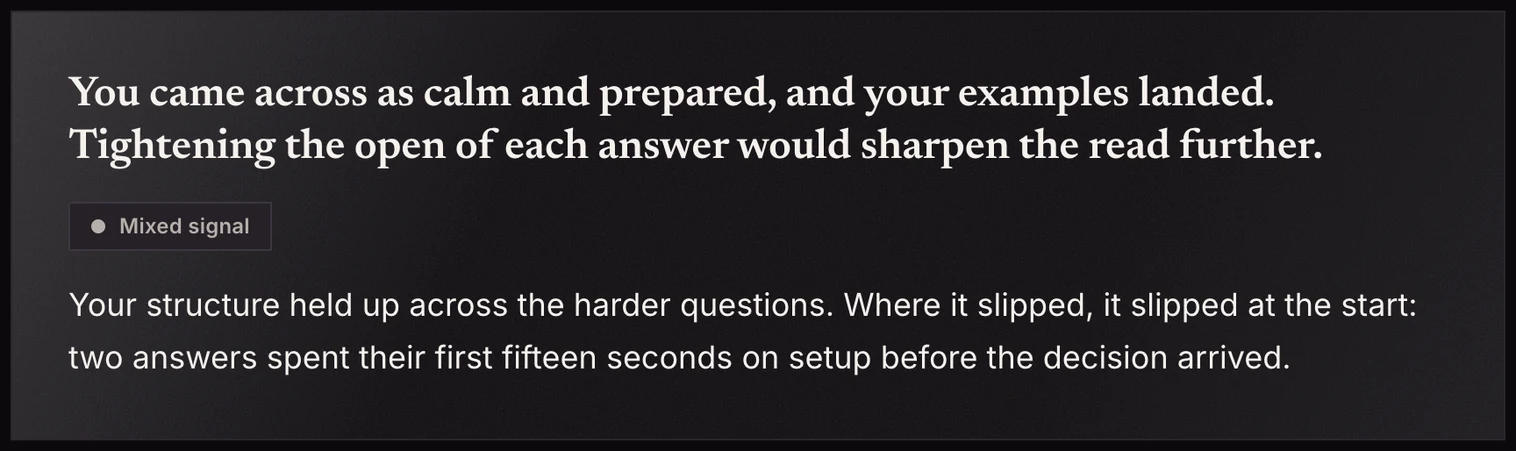
An InterviewSparrow sample report, Section A: the overall verdict “You came across as calm and prepared, and your examples landed. Tightening the open of each answer would sharpen the read further.”, a Mixed signal chip, and the diagnostic underneath.An InterviewSparrow sample report, Section A: the overall verdict “You came across as calm and prepared, and your examples landed. Tightening the open of each answer would sharpen the read further.”, a Mixed signal chip, and the diagnostic underneath.
Section A opens every report: one sentence on how you came across, a band, and the diagnostic behind it.

B. Dimension scores

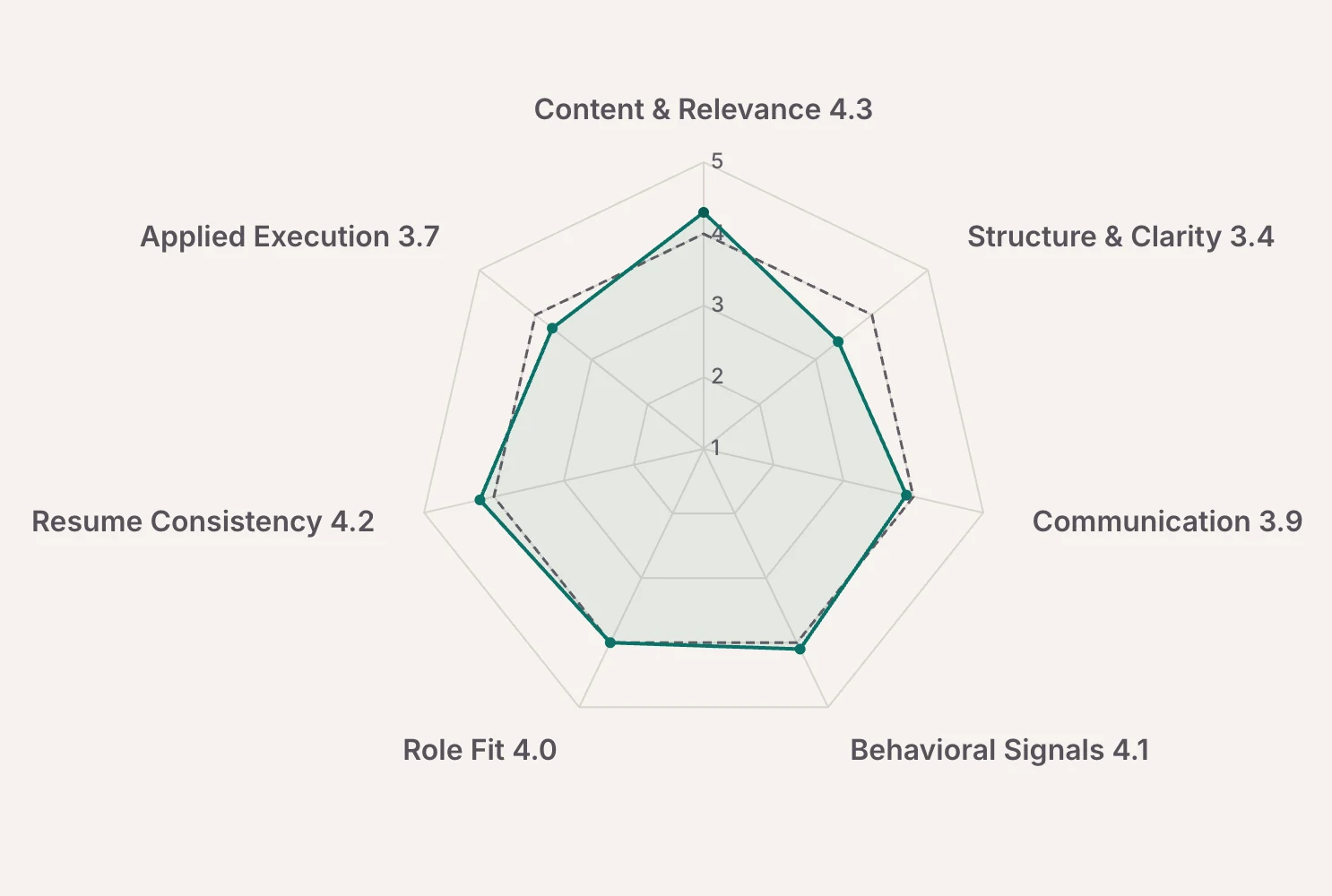
An InterviewSparrow sample report’s seven-dimension radar from Section B. Content & Relevance 4.3, Structure & Clarity 3.4, Communication 3.9, Behavioral Signals 4.1, Role Fit 4.0, Resume Consistency 4.2, Applied Execution 3.7, each plotted against a dashed outline at the fixed 4.0 bar.An InterviewSparrow sample report’s seven-dimension radar from Section B. Content & Relevance 4.3, Structure & Clarity 3.4, Communication 3.9, Behavioral Signals 4.1, Role Fit 4.0, Resume Consistency 4.2, Applied Execution 3.7, each plotted against a dashed outline at the fixed 4.0 bar.
Section B plots your seven dimension scores, each 1–5, against a fixed strong-performance bar of 4.0 — the dashed outline is that bar.
Each dimension opens onto the evidence behind its score: the moments that earned it, and the gap to the fixed 4.0 bar.

C. Per-question breakdown

One entry per question you were asked, in the order you were asked them.

Question 2
Walk me through a project where the deadline moved and you had to decide what to cut.
What you said
So, um, the launch slipped by three weeks and we had to decide what shipped without the reporting layer. I talked to the two teams who needed it and we agreed to hold it for the next release.
What worked
You named the constraint and the trade-off in the first sentence, and you owned the decision rather than describing it happening to you.
What was missing
The outcome never arrived. You said what you cut, but not what shipping without it cost or saved.
Try this next
Close with the result. One sentence on what happened after the release turns a story into evidence.
Your words, replayed:
So, um, the launch slipped by three weeks and we had to decide what shipped without the reporting layer.

In your own report this plays back the audio of that sentence. Nothing plays here.

D. Top 3 priority improvements
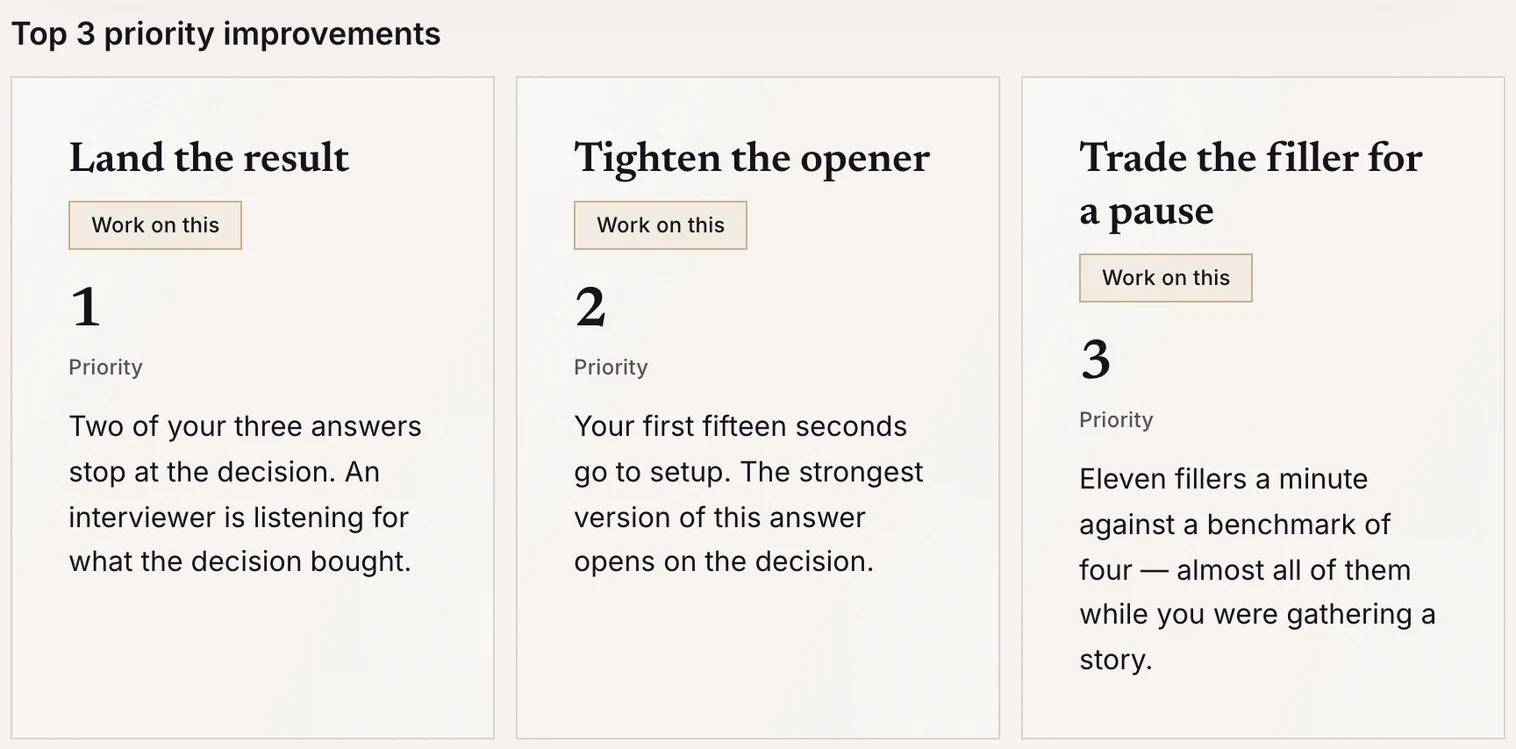
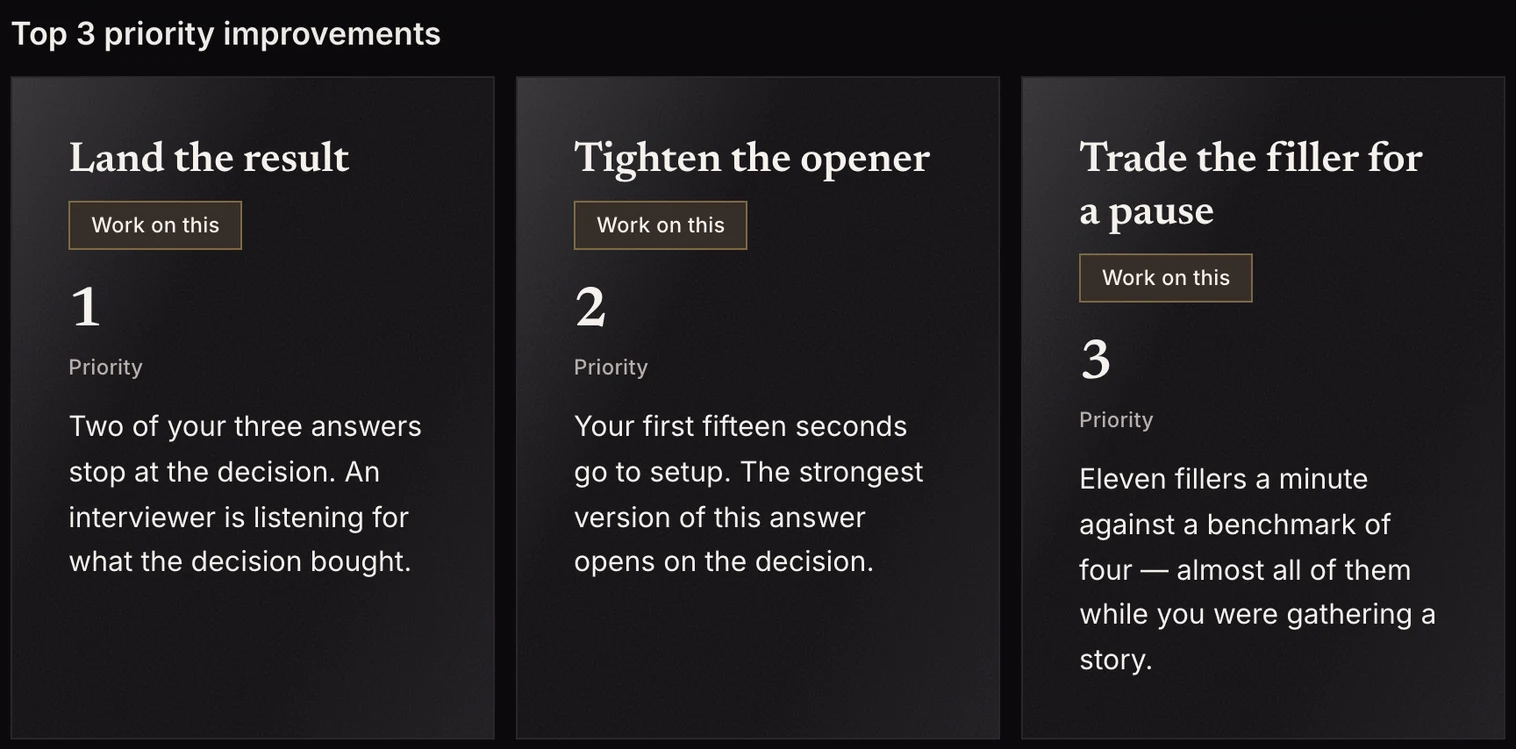
An InterviewSparrow sample report, Section D, “Top 3 priority improvements”: three cards headed “Land the result”, “Tighten the opener” and “Trade the filler for a pause”, each with a Work on this action, its priority number and a short diagnostic.An InterviewSparrow sample report, Section D, “Top 3 priority improvements”: three cards headed “Land the result”, “Tighten the opener” and “Trade the filler for a pause”, each with a Work on this action, its priority number and a short diagnostic.
Section D ranks the three things to fix first, each tied to something you actually said.

E. What to practice next

Section E closes the report with a recommendation for your next session: how long it should run, and what to focus on.