How to prepare for an AI first-round interview
Updated
An AI first-round interview is a screening interview that an employer runs with software instead of a recruiter. You answer questions on screen or out loud, your answers are turned into a transcript and assessed against what the employer set for the job, and the hiring team gets the result. Prepare for it by saying your answers out loud, timed, against the job description, and by rehearsing the follow-up questions. Here is how the usual formats work, what they score, and a plan for the days before.
You take the interview on a desktop or laptop, with your webcam on and your whole screen shared. It does not run on a phone.
A 30-minute interview takes 10 credits.
What an AI first-round interview is
It is the first interview of a hiring process, run by software. The employer chooses the questions and what a good answer has to show, usually from the job description. The software asks the questions, records your answers, turns them into a transcript, and scores or summarizes them for the hiring team.
It lets an employer give every applicant the same first round at any hour, without a recruiter on each call. For you, it means a round with no interviewer’s face to read, questions that do not change with your mood, and time limits that are set before you start.
The three usual formats
Most AI first rounds take one of three forms. Check the invitation for which one you are in, because each tests the same answers in a different way.
| Format | How it runs | What to rehearse |
|---|---|---|
| One-way video | Each question appears on screen. You get a short time to think, then record your answer against a timer, with nobody on the other side. Whether you get a retake is the employer’s setting. | Starting an answer within seconds, finishing inside the time limit, speaking to a camera |
| Live AI interviewer | An AI interviewer talks with you in real time, by voice and sometimes on video, and asks follow-up questions about what you just said. | Holding one story through two or three follow-ups: what exactly you did, and how you know it worked |
| Written or chat screening | A chat window asks written questions about your eligibility, availability and experience, and may book the next step. | Short written answers that name the requirement and your evidence for it |
How answers are usually scored
In most systems your spoken answer is turned into a transcript first, and the transcript is assessed against criteria the employer set for the role: usually skills and behaviors taken from the job description, each with a rating scale. The result is a score, a summary or a recommendation that the hiring team reads before deciding who moves on.
Asking every candidate the same questions and rating the answers against the same criteria is what makes an interview structured, and a 2022 re-analysis of personnel-selection research ranked structured interviews first among the selection procedures it compared for predicting job performance.
That makes the words you say carry most of the weight. What it means for how you answer:
- Answer the question in your first sentence. A long run-up pushes the part that answers it further from the start.
- Use the job description’s words for skills you really have. A criterion written from the job description is easier to match when your answer names it.
- Give one concrete example per answer: the situation in a sentence, what you did yourself, and what happened, with a number if you have one.
- Speak clearly rather than fast. A transcript can only be scored on the words it caught.
If the employer uses InterviewSparrow
Hiring teams can run their first round on InterviewSparrow. If yours does, the AI interviewer you meet is the same one people practice with on InterviewSparrow, and you are scored on the same seven dimensions: content and relevance, structure and clarity, communication, behavioral signals, role-specific fit, consistency with your resume, and applied execution.
Your invitation is a single-use link. You create your own InterviewSparrow account and take the interview when it suits you, on a laptop or desktop with your webcam on and your whole screen shared. Each dimension is scored from 1 to 5 and tied to quotes from your answers, and the hiring team’s recommendation is the plain average of the seven, mapped to one of four levels: yes, weak yes, weak no or no. The page for hiring teams shows the rest of what the team sees.
Other employers use other software, which asks and scores in its own way. For those rounds, practice here rehearses your answers, not the software.
How to prepare out loud
Prepare by saying your answers, not by reading them. A one-way video gives you seconds to start, and a live AI interviewer follows up on what you actually said, so an answer you have only read comes out differently the first time you speak it. A plan for the days before:
- List the four to six requirements the job description repeats, and pick one example from your own work, study or projects for each.
- Say each example out loud in under two minutes: the situation, what you did, what changed. Time yourself.
- Practice starting cold: read a question, take thirty seconds to think, then answer with no notes on screen.
- Rehearse the follow-ups. After each answer, ask yourself “what exactly did you do?” and “how do you know it worked?”, and answer those too.
- Set up as you will on the day: the laptop at eye level, light in front of you, notifications off, and a test recording to check your microphone.
- Run at least one full mock round with an interviewer that follows up, then work on the first thing the feedback names.
Questions to ask before the round
Ask the recruiter how the round works before you start, because the answers change how you prepare. Some places require employers to say part of it up front: New York City’s law on automated employment decision tools requires employers to notify candidates before such a tool is used, and Illinois’ Artificial Intelligence Video Interview Act requires notice, an explanation and consent before AI analyzes a video interview for a job based in the state.
Five questions worth asking:
- Which format is it: one-way video, a live AI interviewer, or written questions?
- How long is it, how long do I have for each answer, and can I retake one?
- What is assessed: only what I say, or the video as well?
- Does a person review the result before a decision is made?
- Can I ask for an adjustment, such as extra time, if I need one?
Practice the round on InterviewSparrow
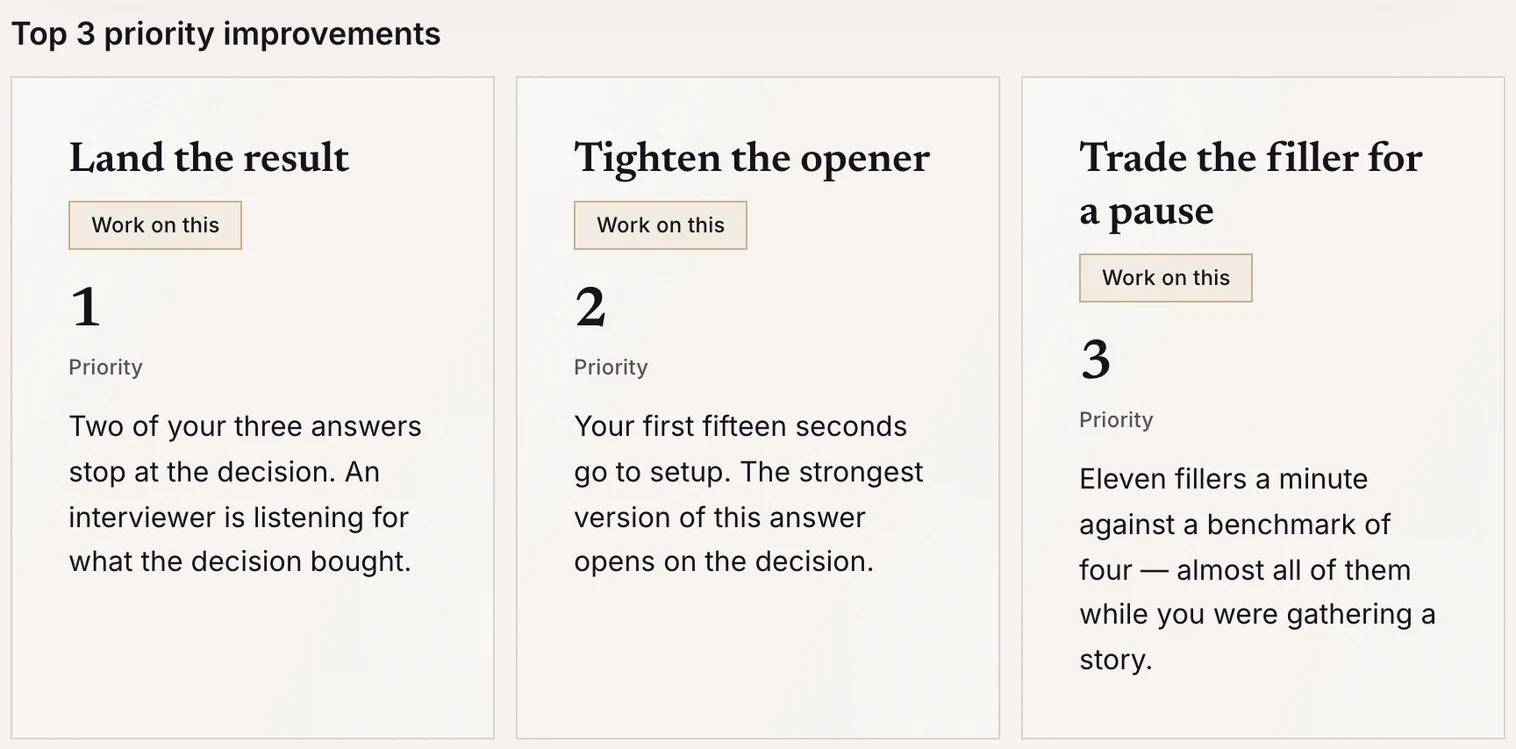
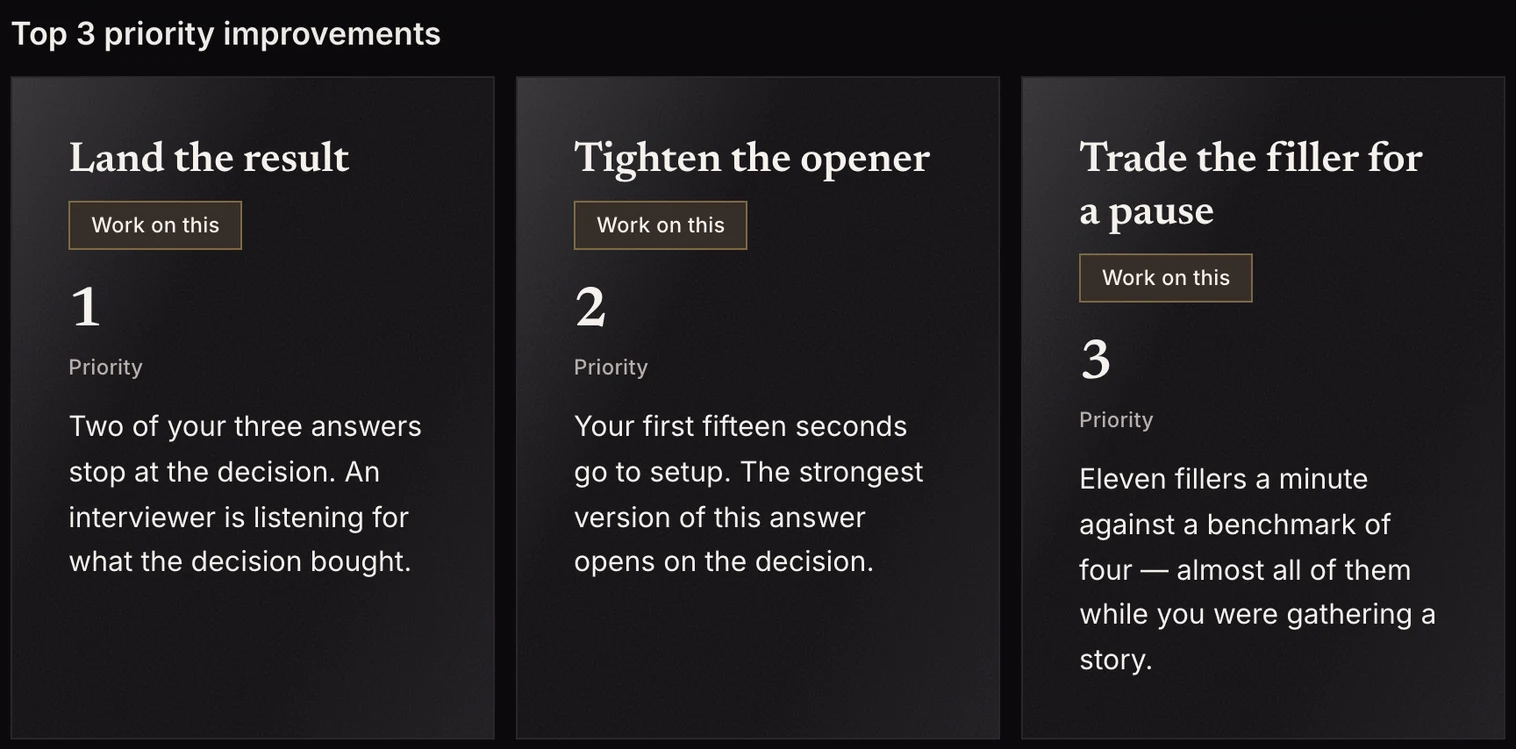
An InterviewSparrow practice round is a live AI interview: built from your resume and the job description, spoken, with follow-up questions and a live exercise, then a report that scores the seven dimensions and ranks the three things to work on first. A 30-minute round shows you where your answers stand before the real one.