Sales mock interview
By Shivangi Jain, Founder · Updated
A sales mock interview on InterviewSparrow is a spoken interview with an AI interviewer, for B2B and B2C sales roles from entry level to senior. It is built from your resume and the role you are aiming for, it includes a live roleplay in which the interviewer plays the buyer, and it is scored against InterviewSparrow’s sales rubric. This page shows what that rubric listens for.
The interview itself runs on a laptop or desktop with your whole screen shared; everything else works on a phone or tablet too.
A 30-minute interview takes 10 credits.
How the interview is set up
You add your resume and the role you are aiming for, and InterviewSparrow reads the role to decide which rubric the interview uses. A sales role, B2B or B2C, gets the sales rubric below. It is written in consultative-selling terms: it rewards investigating the buyer’s situation, and treats a recited script as a weak signal.
Before you start you pick the interview bar too: Entry-level (0–3 yrs), Professional (4–9 yrs) or Senior (10+ yrs). Questions and scoring are calibrated to the experience level you pick.
The live buyer roleplay
Every InterviewSparrow interview includes one hands-on exercise, and for a sales role it is a roleplay. The interviewer picks the situation from the role and level you set up, sets it up in a few short sentences and plays the buyer in a live conversation, and expects you to respond as you would on the call, not to describe how you once handled one.
The rubric’s own live prompts show the range: a buyer who says your price is over budget and a competitor is cheaper, and a champion who has gone quiet since the demo, where you find out what is really in the way and then say what follow-up you would send. One of them asks you to respond without leading with a discount.
The prep screen before the interview puts it this way: “Your exercise for this role is spoken: the interviewer describes a situation and you talk it through. You do not need to open any tool.” Your whole screen is still shared, as in every InterviewSparrow interview, but nothing on it is the work. In a practice session nothing from your camera is recorded or sent, and your screen is not recorded as video; still snapshots of it are kept until you delete them.
Hiring researchers call a test in which candidates do a sample of the job a work sample, and a roleplay is the sales version of the idea. A 2005 meta-analysis of work sample tests found that scores on them relate to measures of job performance, though less strongly than earlier estimates had suggested.
What the sales rubric listens for
The interviewer and the report work from the same sales rubric. It has six competencies, and for each one it lists things an interviewer can actually hear.
Here is each competency with one strong and one weak signal from the rubric, lightly shortened:
- Discovery rigor. Strong: distinguishes the buyer’s stated problem from the underlying business outcome and probes for both. Weak: equates discovery with feature-gating.
- Objection handling. Strong: distinguishes a price objection from a value objection and treats them differently. Weak: defaults to discount as the first response to any pricing pushback.
- Pipeline discipline. Strong: names a recent quarter they pulled deals out of forecast that everyone else expected to close, and what was true that the CRM did not capture. Weak: cannot name a deal they lost because they did not work it for two weeks.
- Value framing. Strong: translates a feature into a buyer-specific metric (hours saved per rep per week, error rate dropped from X to Y) using the buyer’s own numbers from discovery. Weak: cannot translate the product’s primary feature into a number the buyer’s CFO would care about.
- Multi-thread / champion building. Strong: reaches second and third contacts inside the account within the first two weeks — and can explain why each one matters. Weak: single-threads through one contact for the full cycle and treats the champion as the buyer.
- Forecast accuracy & honesty. Strong: tells the manager about a slipping deal before being asked. Weak: cannot recall a specific time they were wrong about a forecast and what they learned.
One of its questions, word for word
The rubric also gives the interviewer probe prompts for each competency, and some of them are live. This one belongs to objection handling:
“Let’s run it live: I’m the buyer, and I’ve just said your price is 30% over our budget and a competitor is cheaper. Respond as you would on the call — without leading with a discount.”
When an answer shows one of the weak signals, the interviewer is told not to accept the abstraction: it follows up and asks for a quantified outcome, a specific example, or the trade-off you considered. A strong answer here treats the pushback as information, as the rubric’s first strong signal for objections does: it separates a price objection from a value objection before it answers.
If you are new to sales, a roleplay from a class, a retail job or a fundraising drive can show the same habits. What the rubric listens for is how you find out what is in the way before you try to answer it.
What the report scores
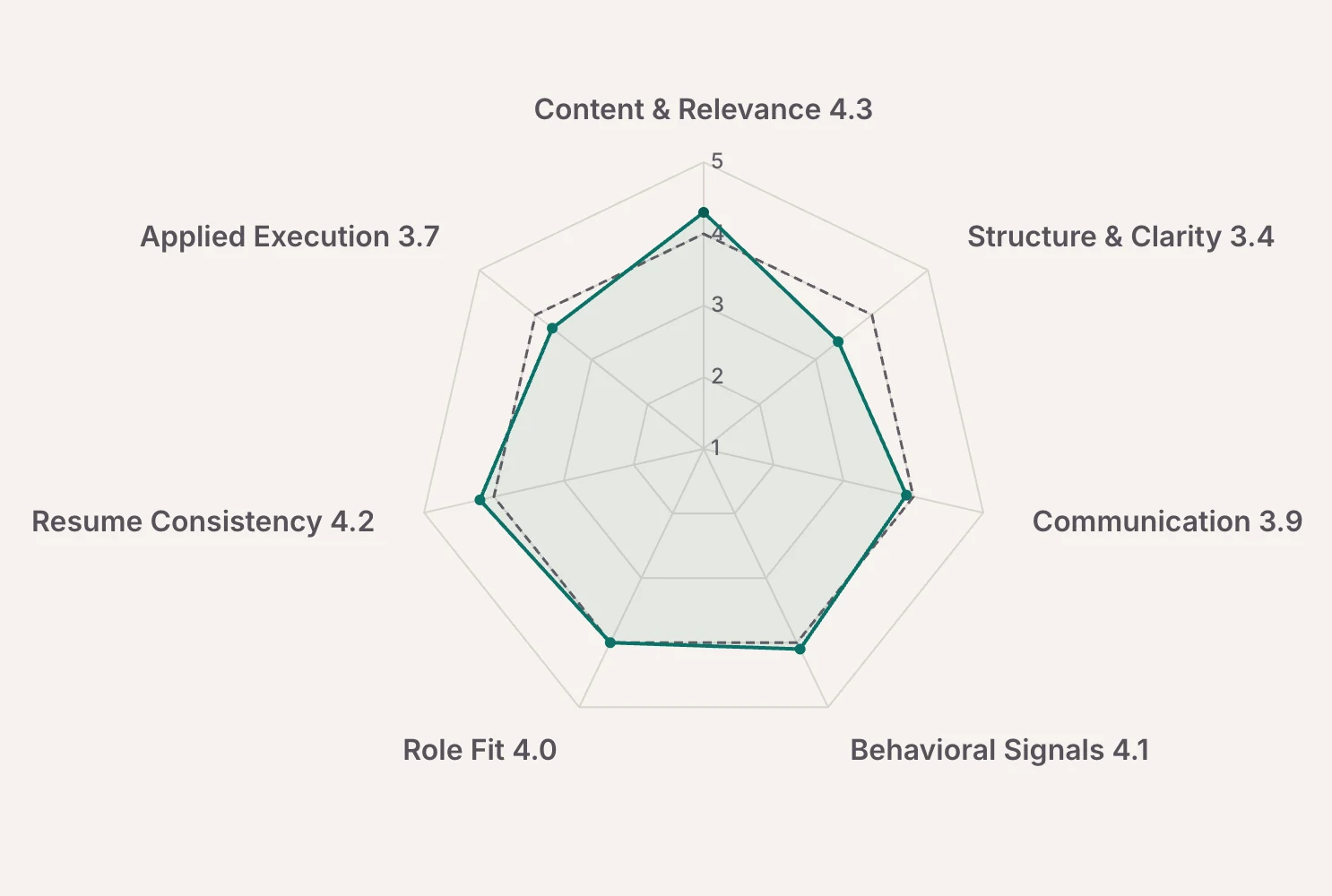
After the interview you get a written report. It scores seven dimensions — content and relevance, structure and clarity, communication, behavioral signals, role-specific fit, consistency with your resume, and applied execution — each 1–5 against a fixed strong-performance bar (4.0), judged against the sales rubric and every score tied to something you said.
Applied execution is the live roleplay: how you handled the buyer, judged against the sales rubric’s competencies.
It closes with the three things to work on first, each drawn from your own answers, and a Mirror Snippet: a short clip of one of your answers, played back with its fillers and pauses.
Common questions
A sales mock interview on InterviewSparrow covers six competencies: discovery rigor, objection handling, pipeline discipline, value framing, multi-threading and champion building, and forecast accuracy and honesty.
A sales mock interview on InterviewSparrow includes one live roleplay in which the AI interviewer plays the buyer and you respond as you would on the call, out loud.
A sales mock interview suits any level, because you pick the interview bar (Entry-level, Professional or Senior) and the questions and scoring are calibrated to it.