Customer success mock interview
By Shivangi Jain, Founder · Updated
A customer success mock interview on InterviewSparrow is a spoken interview with an AI interviewer, for customer success managers, support engineers, technical account managers and customer support roles. It is built from your resume and the role you are aiming for, it includes a live roleplay in which the interviewer plays the customer, and it is scored against InterviewSparrow’s customer success and support rubric. This page shows what that rubric listens for.
The interview itself runs on a laptop or desktop with your whole screen shared; everything else works on a phone or tablet too.
A 30-minute interview takes 10 credits.
How the interview is set up
You add your resume and the role you are aiming for, and InterviewSparrow reads the role to decide which rubric the interview uses. The customer success and support rubric covers customer success managers, support engineers and technical account managers, and it leans toward empathy, retention impact and advocacy for the customer across the company.
The setup also asks for the interview bar: Entry-level (0–3 yrs), Professional (4–9 yrs) or Senior (10+ yrs). Questions and scoring are calibrated to the experience level you pick.
The live customer roleplay
Every InterviewSparrow interview includes one hands-on exercise, and for a customer success role it is a roleplay. The interviewer picks the situation from the role and level you set up, sets it up in a few short sentences and plays the customer on a live call, and you take the call out loud instead of describing how you once handled one.
The rubric’s own live prompts show the range: a customer whose account has been locked for two days before a big deadline and who is angry, and a customer who keeps venting with ten minutes left. In both you acknowledge the person and move the call toward a next step without making them feel cut off.
The prep screen before the interview puts it this way: “Your exercise for this role is spoken: the interviewer describes a situation and you talk it through. You do not need to open any tool.” Your whole screen is still shared, as in every InterviewSparrow interview, but nothing on it is the work. In a practice session nothing from your camera is recorded or sent, and your screen is not recorded as video; still snapshots of it are kept until you delete them.
The US Office of Personnel Management describes an interactive role-play between an applicant and a trained actor as one way to measure problem solving, communication and interpersonal skills, and its example is a job where customers can be upset or hostile.
What the customer success rubric listens for
The interviewer and the report work from the same customer success and support rubric. It has six competencies, and for each one it lists things an interviewer can actually hear.
Here is each competency with one strong and one weak signal from the rubric, lightly shortened:
- Empathy without losing the thread. Strong: reaches for a recap of what they heard before proposing a next step — and is willing to be corrected. Weak: leaps to solutioning before the customer feels heard.
- Escalation judgment. Strong: names the criteria they use to decide when to escalate (risk to renewal, regulatory, repeat issue, technical depth) — not just by anger level. Weak: escalates by default whenever the customer raises their voice.
- Documentation discipline. Strong: talks about catching a documentation gap from a repeat ticket and closing it rather than re-answering. Weak: re-answers the same question across multiple tickets without writing it down once.
- Quantified retention / CSAT outcomes. Strong: names their book-of-business retention rate or CSAT score with the time window and baseline. Weak: reports CSAT as a single number with no context or baseline.
- Cross-functional advocacy for customers. Strong: distinguishes a single customer’s pain from a pattern across the book and treats them differently in advocacy. Weak: cannot name a recent product change they influenced.
- Pattern detection across tickets. Strong: distinguishes a one-off ticket from an emerging trend and acts on the trend earlier. Weak: handles each ticket in isolation and is surprised when the same one comes back next month.
One of its questions, word for word
The rubric also gives the interviewer probe prompts for each competency, and some of them are live. This one belongs to empathy without losing the thread:
“Let’s do it live: I’m a customer whose account has been locked for two days before a big deadline, and I’m angry. Take the call — acknowledge me and get us to a next step.”
When an answer shows one of the weak signals, the interviewer is told not to accept the abstraction: it follows up and asks for a quantified outcome, a specific example, or the trade-off you considered. A strong answer names the customer’s emotional state explicitly and then redirects without dismissing, which is the rubric’s first strong signal for this competency.
If you have not worked in customer success before, a hard conversation with a customer or a member of the public in any job answers the same question. What the rubric listens for is whether the person feels heard and the call still reaches a next step.
What the report scores
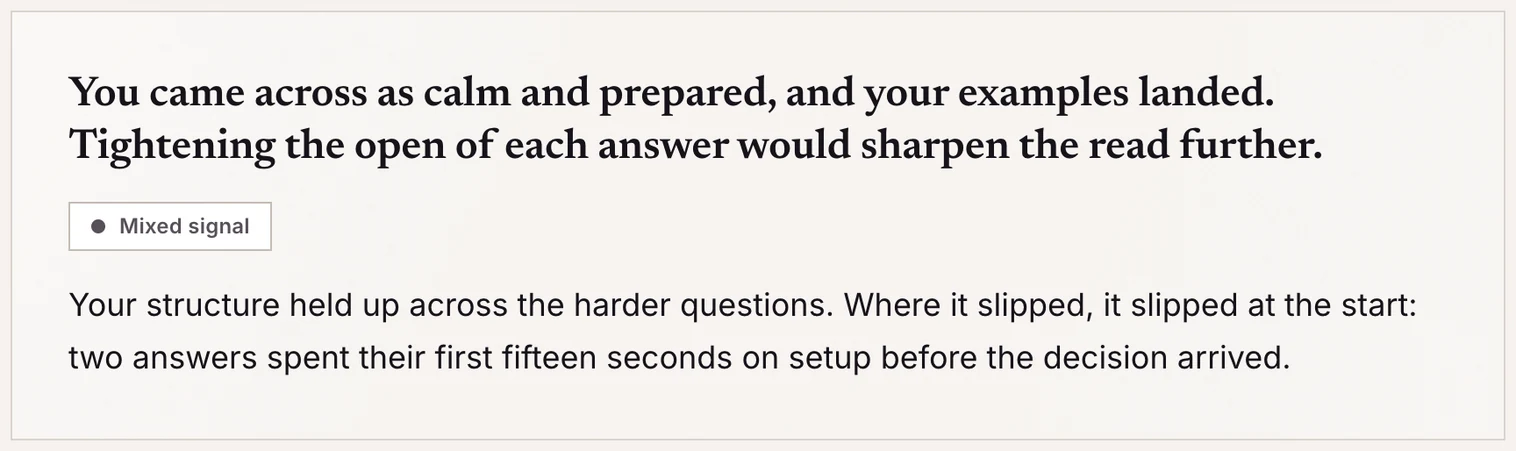
After the interview you get a written report. It scores seven dimensions — content and relevance, structure and clarity, communication, behavioral signals, role-specific fit, consistency with your resume, and applied execution — each 1–5 against a fixed strong-performance bar (4.0), judged against the customer success rubric and every score tied to something you said.
Applied execution is the live roleplay: how you handled the call, judged against the rubric’s competencies for your role.
The report also ranks the three things to work on first, each drawn from your own answers, and plays back a Mirror Snippet: a short clip of one of your answers, fillers and pauses included.
Common questions
A customer success mock interview on InterviewSparrow covers six competencies: empathy without losing the thread, escalation judgment, documentation discipline, quantified retention and CSAT outcomes, cross-functional advocacy for customers, and pattern detection across tickets.
The AI interviewer plays the customer in a customer success mock interview: it sets the situation up in a few short sentences and you take the call out loud, with no tool to open.
The customer success rubric covers customer success managers, support engineers, technical account managers and customer support roles.