Marketing mock interview
By Shivangi Jain, Founder · Updated
A marketing mock interview on InterviewSparrow is a spoken interview with an AI interviewer, for performance, brand, content and lifecycle marketing roles from entry level to senior. It is built from your resume and the role you are aiming for, it includes a live exercise in which you write a short campaign brief or piece of copy on your own screen, and it is scored against InterviewSparrow’s marketing rubric. This page shows what that rubric listens for.
The interview itself runs on a laptop or desktop with your whole screen shared; everything else works on a phone or tablet too.
A 30-minute interview takes 10 credits.
How the interview is set up
You add your resume and the role you are aiming for, and InterviewSparrow reads the role to decide which rubric the interview uses. The marketing rubric covers performance, brand, content and lifecycle marketing, and it favors quantified outcomes and honest attribution over campaign theater.
Before you start you pick the interview bar too: Entry-level (0–3 yrs), Professional (4–9 yrs) or Senior (10+ yrs). Questions and scoring are calibrated to the experience level you pick.
The live written brief
Every InterviewSparrow interview includes one hands-on exercise, and for a marketing role it is written: the interviewer sets up a campaign situation and asks you to write out a short campaign brief or piece of copy on your shared screen. You work in any plain document, spreadsheet or whiteboard you already use, since InterviewSparrow has no built-in editor, and the interviewer leaves you quiet time while you write.
The rubric’s own prompt for the exercise gives a feel for it: a paid-social campaign that converts at half the rate of search, with a budget review next month, and a request to state the hypothesis, the test you would run and the result that would make you stop. A manager or leader title, such as marketing manager or head of marketing, gets a spoken scenario instead of a written brief.
In a practice session nothing from your camera is recorded or sent, and your screen is not recorded as video; still snapshots of your on-screen work are kept until you delete them.
Kansas State University’s College of Business career development team tells marketers to show results with before and after data, such as click-through rates, conversion rates, engagement numbers and ROI. The quantified outcome competency below asks for the same thing: a number against a baseline.
What the marketing rubric listens for
The interviewer and the report work from the same marketing rubric. It has six competencies, and for each one it lists things an interviewer can actually hear.
Here is each competency with one strong and one weak signal from the rubric, lightly shortened:
- Funnel literacy & attribution honesty. Strong: distinguishes a conversion-rate problem from a volume problem and names which stage they are debugging right now. Weak: treats last-touch attribution as truth and credits whatever channel got the click.
- Campaign hypothesis → test → learn discipline. Strong: states the hypothesis in if-then form before naming the creative or the channel. Weak: defines campaign success after the data comes in.
- Brand vs performance trade-off articulation. Strong: distinguishes a CAC problem caused by brand erosion from one caused by channel saturation. Weak: cannot name a single brand metric they track over months, not days.
- Quantified outcome framing. Strong: names a vanity metric they used to over-report and have since dropped. Weak: uses impressions, opens or page-views as primary success metrics.
- Cross-functional story craft. Strong: names a recent positioning shift that came from listening to sales-call recordings rather than a strategy doc. Weak: hands sales a messaging document and treats adoption as their problem.
- Channel-mix strategy. Strong: names the channel they have personally killed and why — not just the ones they have launched. Weak: replicates the channel mix from a previous role without re-testing assumptions about the new audience.
One of its questions, word for word
The rubric also gives the interviewer probe prompts for each competency, and some of them are live. This one belongs to the hypothesis, test and learn competency:
“Let’s design one now: our paid-social campaign converts at half the rate of search, and the budget review is next month. State the hypothesis, the test you’d run and the result that would make you stop — use the shared screen if it helps.”
When an answer shows one of the weak signals, the interviewer is told not to accept the abstraction: it follows up and asks for a quantified outcome, a specific example, or the trade-off you considered. A strong answer states the hypothesis in if-then form before it names a creative or a channel, as the rubric’s first strong signal for this competency does.
If you are new to marketing, a campaign from a class, a club or a personal project can answer the same questions. What the rubric listens for is the hypothesis and the result that would change your mind, not the size of the budget.
What the report scores
After the interview you get a written report. It scores seven dimensions — content and relevance, structure and clarity, communication, behavioral signals, role-specific fit, consistency with your resume, and applied execution — each 1–5 against a fixed strong-performance bar (4.0), judged against the marketing rubric and every score tied to something you said.
Applied execution is the live exercise. When your shared screen could be read, it is scored mainly from the brief or copy you wrote; otherwise from how you worked through it out loud.
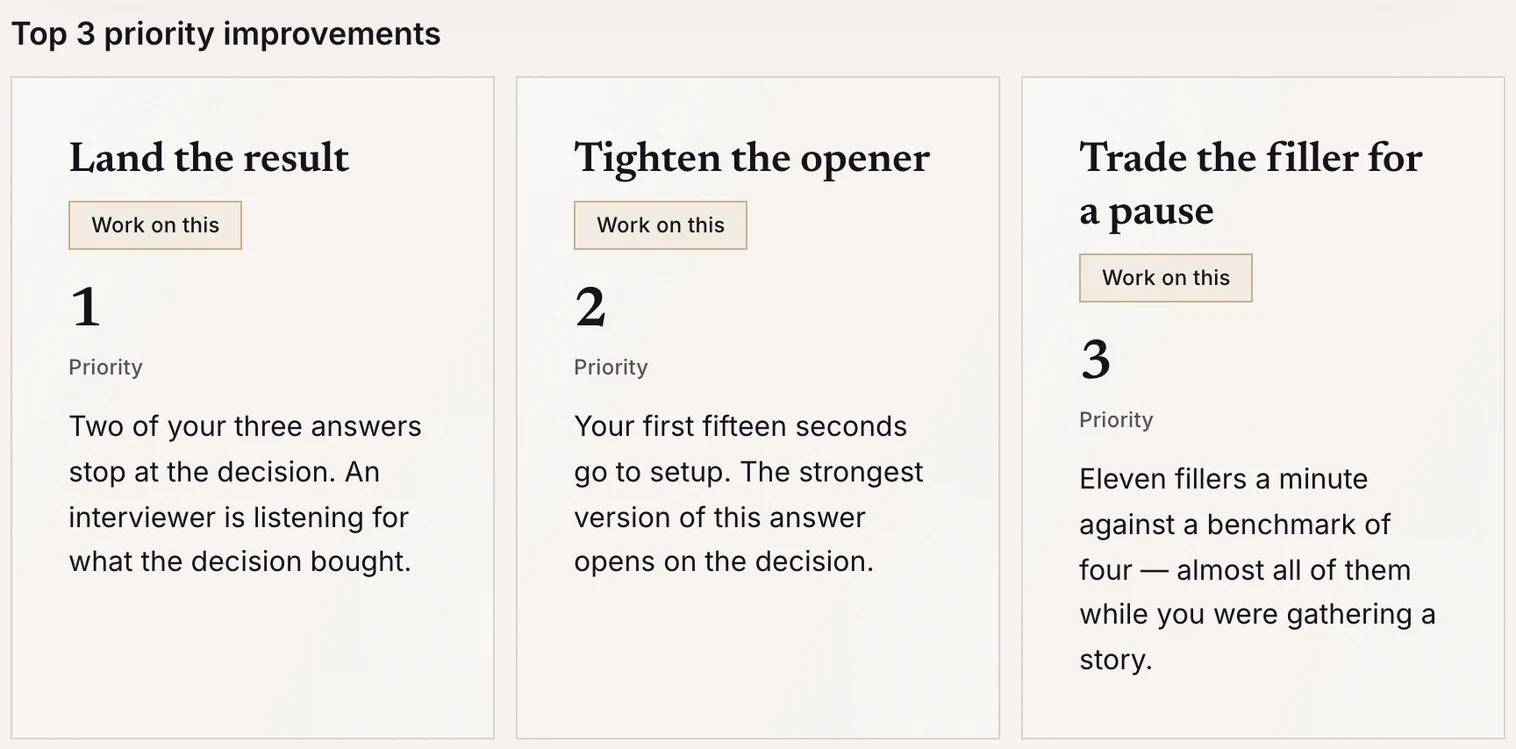
The report also ranks the three things to work on first, each drawn from your own answers, and plays back a Mirror Snippet: a short clip of one of your answers, fillers and pauses included.
Common questions
A marketing mock interview on InterviewSparrow covers six competencies: funnel literacy and attribution honesty, hypothesis-driven campaign testing, brand versus performance trade-offs, quantified outcome framing, cross-functional story craft, and channel-mix strategy.
A marketing mock interview includes one exercise in which you write a short campaign brief or piece of copy in any plain document, sheet or whiteboard on your shared screen; a manager or leader title gets a spoken scenario instead.
The marketing rubric covers performance, brand, content and lifecycle marketing roles, and it is calibrated to the interview bar you pick: Entry-level, Professional or Senior.