Project manager mock interview
By Shivangi Jain, Founder · Updated
A project manager mock interview on InterviewSparrow is a spoken interview with an AI interviewer, for project managers, program managers, technical program managers, delivery managers, scrum masters and agile coaches. It is built from your resume and the role you are aiming for, it includes a live delivery scenario that you talk through, and it is scored against InterviewSparrow’s delivery rubric. This page shows what that rubric listens for.
The interview itself runs on a laptop or desktop with your whole screen shared; everything else works on a phone or tablet too.
A 30-minute interview takes 10 credits.
How the interview is set up
You add your resume and the role you are aiming for, and InterviewSparrow reads the role to decide which rubric the interview uses. The delivery rubric covers project and program managers, technical program managers, delivery managers, scrum masters and agile coaches. It is about the how, the when and the who-and-by-when, where the product rubric is about the what and the why, shown on the product manager mock interview page.
The setup also asks for the interview bar: Entry-level (0–3 yrs), Professional (4–9 yrs) or Senior (10+ yrs). Questions and scoring are calibrated to the experience level you pick.
The live delivery scenario
Every InterviewSparrow interview includes one hands-on exercise, and for a project manager it is a spoken scenario about a schedule, a risk or a stakeholder. The interviewer picks it from the role and level you set up and describes it in a few short sentences, and you talk it through, deciding in the moment instead of recounting a project from the past.
The rubric’s own live prompts show the range: a customer-facing release across three teams, due in eight weeks, with half the requirements still unknown, and a team that tells you two weeks in that its piece will be three weeks late, which you re-plan on the spot. The first asks you where the critical path is, and the second what you say to the stakeholder first.
The prep screen before the interview puts it this way: “Your exercise for this role is spoken: the interviewer describes a situation and you talk it through. You do not need to open any tool.” Your whole screen is still shared, as in every InterviewSparrow interview, but nothing on it is the work. In a practice session nothing from your camera is recorded or sent, and your screen is not recorded as video; still snapshots of it are kept until you delete them.
The University of Miami’s Toppel Career Center lists how you set timelines, what you do when a project has gone completely off track, and how you deal with scope creep among ten common project manager interview questions. They are the ground of the planning, risk and scope competencies below.
What the delivery rubric listens for
The interviewer and the report work from the same delivery rubric. It has six competencies, and for each one it lists things an interviewer can actually hear. It leans toward shipped value, surfaced risk and unblocked teams, and away from ceremony and status-meeting busywork.
Here is each competency with one strong and one weak signal from the rubric, lightly shortened:
- Planning & estimation under uncertainty. Strong: talks about estimates as ranges with confidence, and explains how they tightened the range as unknowns resolved. Weak: presents a single-date plan with no buffer and no statement of what it assumes.
- Risk & dependency management. Strong: names a risk they retired early by acting on it weeks before it could bite. Weak: confuses logging a risk with managing it.
- Scope & change control. Strong: makes the cost of scope creep explicit in time or risk before the decision is made. Weak: absorbs every new request without renegotiating the date or surfacing the cost.
- Stakeholder alignment & communication. Strong: delivers bad news early with options attached rather than waiting for a steering meeting. Weak: reports green until the week it goes red.
- Agile delivery & process adaptation. Strong: talks about a ceremony they dropped or reshaped because it was not earning its time. Weak: measures success by ceremony attendance or velocity as a target rather than a diagnostic.
- Cross-functional execution & unblocking. Strong: names a blocker they personally unblocked by going to the right person, not by filing a ticket. Weak: lets action items decay between meetings with no owner or date.
One of its questions, word for word
The rubric also gives the interviewer probe prompts for each competency, and some of them are live. This one belongs to planning and estimation:
“Live: two weeks in, one team tells you their piece will be three weeks late. Re-plan it with me now, and tell me what you say to the stakeholder first.”
When an answer shows one of the weak signals, the interviewer is told not to accept the abstraction: it follows up and asks for a quantified outcome, a specific example, or the trade-off you considered. A strong answer does what the rubric’s third strong signal for planning describes: it re-baselines the plan, says what gets cut and names who is told first.
If you have not carried the title yet, a project you organized at work, at school or as a volunteer answers the same questions. What the rubric listens for is the plan and the order of your decisions, not the size of the budget.
What the report scores
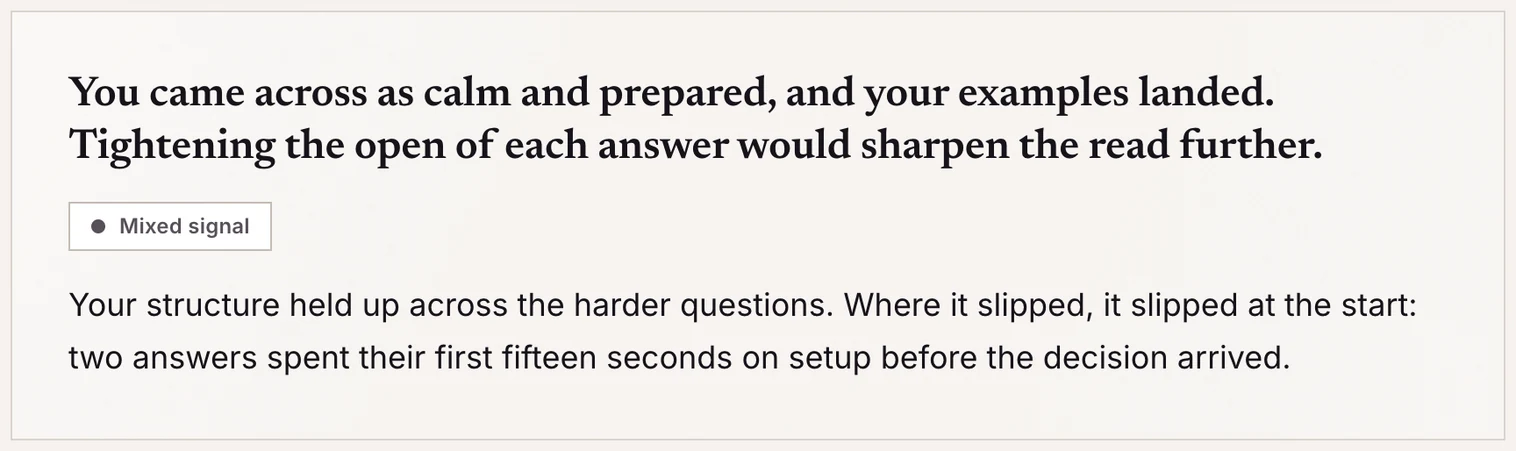
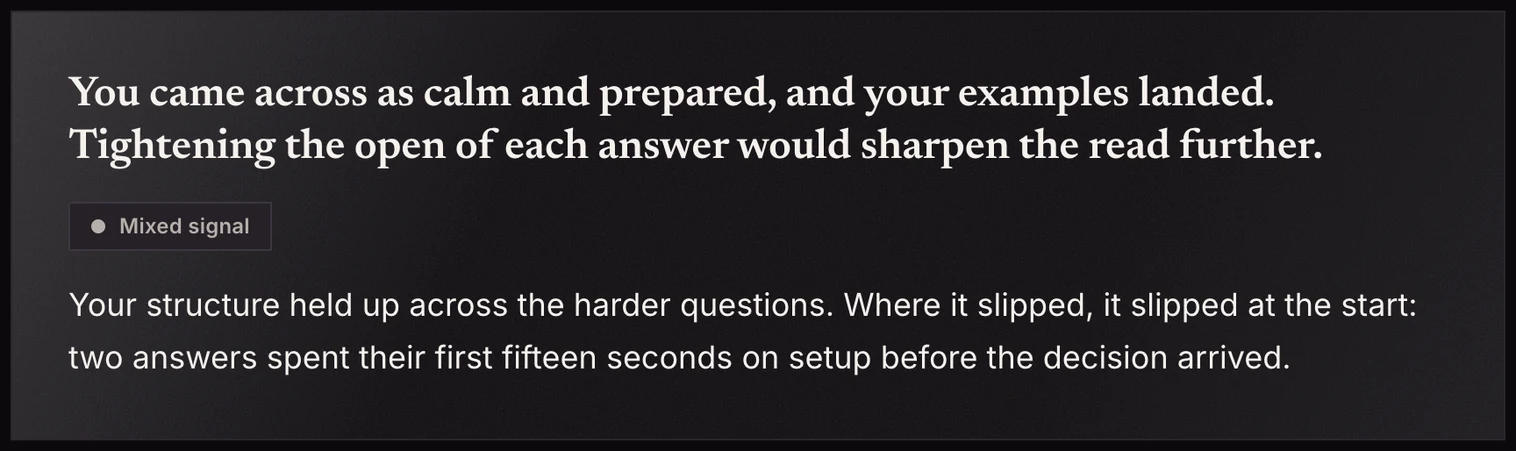
After the interview you get a written report. It scores seven dimensions — content and relevance, structure and clarity, communication, behavioral signals, role-specific fit, consistency with your resume, and applied execution — each 1–5, judged against the delivery rubric and every score tied to something you said.
Applied execution is the live scenario: how you worked through it, judged against the delivery rubric’s competencies.
The report also ranks the three things to work on first, each drawn from your own answers, and plays back a Mirror Snippet: a short clip of one of your answers, fillers and pauses included.
Common questions
A project manager mock interview on InterviewSparrow covers six competencies: planning and estimation under uncertainty, risk and dependency management, scope and change control, stakeholder alignment and communication, agile delivery and process adaptation, and cross-functional execution and unblocking.
The delivery rubric behind the project manager mock interview covers project managers, program managers, technical program managers, delivery managers, scrum masters and agile coaches.
The live exercise in a project manager mock interview is a spoken scenario about a schedule, a risk or a stakeholder, which the AI interviewer describes in a few short sentences and you talk through, with no tool to open.