Product manager mock interview
By Shivangi Jain, Founder · Updated
A product manager mock interview on InterviewSparrow is a spoken interview with an AI interviewer, for product management roles from entry level to senior. It is built from your resume and the role you are aiming for, it includes a live product case that you reason through aloud, and it is scored against InterviewSparrow’s product rubric. This page shows what that rubric listens for.
The interview itself runs on a laptop or desktop with your whole screen shared; everything else works on a phone or tablet too.
A 30-minute interview takes 10 credits.
How the interview is set up
You add your resume and the role you are aiming for, and InterviewSparrow reads the role to decide which rubric the interview uses. The product rubric covers product management craft from discovery through delivery. Project and program roles get the delivery rubric instead, shown on the project manager mock interview page.
Before you start you pick the interview bar too: Entry-level (0–3 yrs), Professional (4–9 yrs) or Senior (10+ yrs). Questions and scoring are calibrated to the experience level you pick.
The live product case
Every InterviewSparrow interview includes one hands-on exercise, and for a product manager it is a product case that you reason through aloud. The interviewer picks it from the role and level you set up and describes it in a few short sentences, and you make the decisions in the moment instead of recounting a launch from the past.
The rubric’s own live prompts show what a case can look like: a chief executive who wants a feature shipped this quarter because a big prospect asked for it, or weekly use of a core feature falling while sales asks for a new feature to win it back. Either way, the question is what you find out before you pick a solution.
The prep screen before the interview puts it this way: “Your exercise for this role is spoken: the interviewer describes a situation and you talk it through. You do not need to open any tool.” Your whole screen is still shared, as in every InterviewSparrow interview, but nothing on it is the work. In a practice session nothing from your camera is recorded or sent, and your screen is not recorded as video; still snapshots of it are kept until you delete them.
Harvard’s Mignone Center for Career Success, in a guide to product manager interviews, tells candidates not to jump straight to a solution on a product design question, and to break a drop in usage into its possible causes before answering. The first competency below is the same habit.
What the product rubric listens for
The interviewer and the report work from the same product rubric. It has six competencies, and for each one it lists things an interviewer can actually hear. It leans toward outcome language, problem-first thinking and trade-offs made under constraint.
Here is each competency with one strong and one weak signal from the rubric, lightly shortened:
- Problem identification before solution jumping. Strong: restates the problem in the user’s words and names the underlying job-to-be-done before sketching a solution. Weak: frames every problem at the same altitude regardless of strategic importance.
- Prioritization under constraint. Strong: states what they cut from the roadmap and why, not just what they shipped. Weak: says yes to all stakeholder requests and treats backlog growth as success.
- Stakeholder navigation. Strong: distinguishes who needs to be consulted from who needs to approve from who needs to be informed and acts accordingly. Weak: treats every meeting as needing every stakeholder in the room.
- Outcome vs output framing. Strong: reports a quarter in outcomes (retention moved from X% to Y%, time-to-first-value dropped from N to M) rather than features shipped. Weak: cannot name the outcome metric for their last shipped initiative.
- Experiment design & interpretation. Strong: states the hypothesis, the success metric and the kill criterion before designing the experiment. Weak: declares a winner at peek-time or with no power analysis.
- Vision-to-execution storytelling. Strong: tells the same story differently to engineering, design, sales and executives — with the same underlying spine. Weak: talks about vision in language that only makes sense inside the product team.
One of its questions, word for word
The rubric also gives the interviewer probe prompts for each competency, and some of them are live. This one belongs to problem identification before solution jumping:
“Live: I’m the CEO, and I want a specific feature shipped this quarter because a big prospect asked for it. Talk to me the way you would in that meeting — what do you ask before you say yes or no?”
When an answer shows one of the weak signals, the interviewer is told not to accept the abstraction: it follows up and asks for a quantified outcome, a specific example, or the trade-off you considered. A strong answer asks about the user and the problem first, the way the rubric’s strong signals for this competency do, before it says yes or no.
If you are moving into product from another role, a feature request you pushed back on in any job answers the same question. What the rubric listens for is the question you ask before you commit.
What the report scores
After the interview you get a written report. It scores seven dimensions — content and relevance, structure and clarity, communication, behavioral signals, role-specific fit, consistency with your resume, and applied execution — each 1–5 against a fixed strong-performance bar (4.0), judged against the product rubric and every score tied to something you said.
Applied execution is the live case: how you reasoned through it, judged against the product rubric’s competencies.
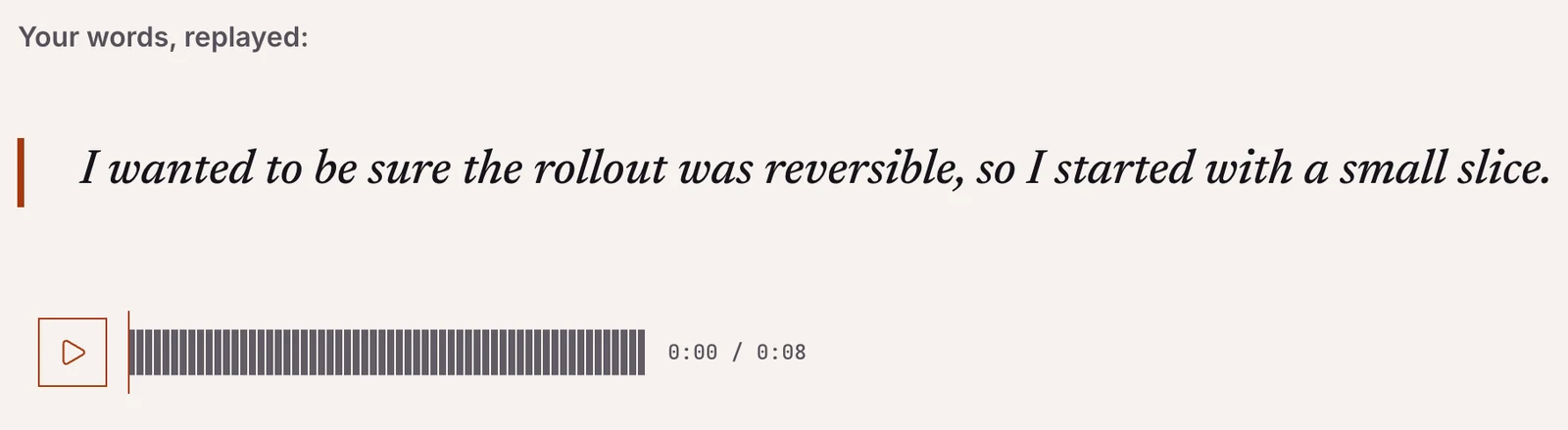
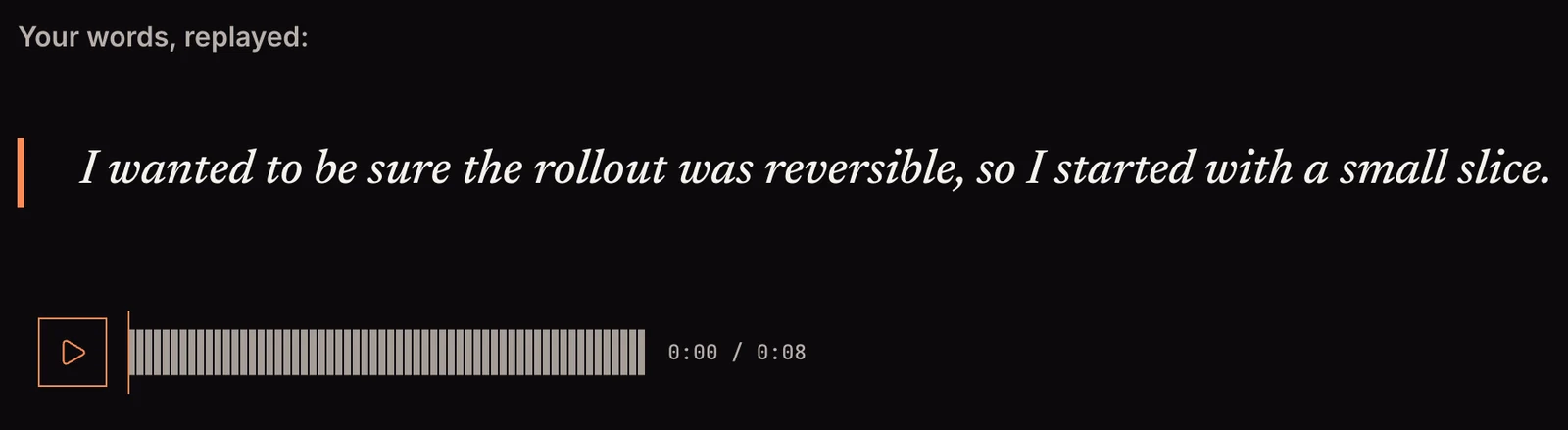
It closes with the three things to work on first, each drawn from your own answers, and a Mirror Snippet: a short clip of one of your answers, played back with its fillers and pauses.
Common questions
A product manager mock interview on InterviewSparrow covers six competencies: problem identification before solution jumping, prioritization under constraint, stakeholder navigation, outcome versus output framing, experiment design and interpretation, and vision-to-execution storytelling.
The product manager exercise is a product case that the AI interviewer describes in a few short sentences and you reason through aloud, with no tool to open.
A product manager mock interview suits someone moving into product, because its questions ask about decisions and reasoning, and a feature request, a priority call or an experiment from any job can serve as your example.