Operations and finance mock interview
By Shivangi Jain, Founder · Updated
An operations and finance mock interview on InterviewSparrow is a spoken interview with an AI interviewer, for operations, finance, FP&A and revenue operations roles from entry level to senior. It is built from your resume and the role you are aiming for, it includes a live exercise in which you work a small calculation or table in any spreadsheet on your own screen, and it is scored against InterviewSparrow’s operations and finance rubric. This page shows what that rubric listens for.
The interview itself runs on a laptop or desktop with your whole screen shared; everything else works on a phone or tablet too.
A 30-minute interview takes 10 credits.
How the interview is set up
You add your resume and the role you are aiming for, and InterviewSparrow reads the role to decide which rubric the interview uses. The operations and finance rubric covers operations, finance, FP&A and revenue operations, and it listens for analytical depth, control discipline and the partnership skills that separate a finance or operations partner from someone who only runs the numbers.
Before you start you pick the interview bar too: Entry-level (0–3 yrs), Professional (4–9 yrs) or Senior (10+ yrs). Questions and scoring are calibrated to the experience level you pick.
The live worked table
Every InterviewSparrow interview includes one hands-on exercise, and for an operations or finance role it is a worked table: the interviewer sets up a small calculation or table and asks you to work it on your shared screen, in any sheet you already use. InterviewSparrow has no built-in editor, so you bring your own, and the interviewer leaves you quiet time while you work.
The rubric’s own live prompts show what that can be: a subscription business with 10,000 customers, 3% monthly churn and a price rise next quarter, built line by line with its drivers, its assumptions and the first check you would run, and then the same model after a chief financial officer says the churn assumption could be off by half. A manager or leader title, such as finance manager or head of operations, gets a spoken scenario instead of a worked table.
In a practice session nothing from your camera is recorded or sent, and your screen is not recorded as video; still snapshots of your on-screen work are kept until you delete them.
The University of Virginia’s Career Center says employers in finance technical interviews are often just as interested in the process you use to solve a challenge as in your answer, and it advises candidates to explain their thought process as they work. The modeling competency below listens for the same thing: assumptions named and drivers kept apart from outputs.
What the operations and finance rubric listens for
The interviewer and the report work from the same operations and finance rubric. It has six competencies, and for each one it lists things an interviewer can actually hear.
Here is each competency with one strong and one weak signal from the rubric, lightly shortened:
- Modeling rigor. Strong: calls out the three or four assumptions doing the most work in their model and names what would have to be true for them to break. Weak: hardcodes numbers inside formulas where a driver belongs.
- Variance analysis storytelling. Strong: distinguishes timing variance (we will catch up) from structural variance (the assumption was wrong) and treats them differently. Weak: reports variances as a list of percentages without naming which ones matter.
- Cross-functional partnership with non-finance teams. Strong: talks about translating finance constraints into language the other team can act on, without losing the constraint. Weak: treats every spend request as a default no.
- Audit-trail discipline. Strong: talks about a moment an audit or board review came up and they could reconstruct the work in minutes because the trail was good. Weak: cannot reconstruct how they got to a number from three months ago.
- Forecast honesty. Strong: tells leadership about a forecast slip before they have to ask. Weak: provides only a single point estimate, never a range.
- Process improvement instinct. Strong: names a specific manual process they automated or eliminated and the hours-per-month saved. Weak: cannot name a process they have streamlined in the last six months.
One of its questions, word for word
The rubric also gives the interviewer probe prompts for each competency, and some of them are live. This one belongs to modeling rigor:
“Live: I’m the CFO, and I’ve just told you the churn assumption could be off by half. Show me what that does to the model’s answer.”
When an answer shows one of the weak signals, the interviewer is told not to accept the abstraction: it follows up and asks for a quantified outcome, a specific example, or the trade-off you considered. A strong answer here treats sensitivity analysis as a default step, which is one of the rubric’s strong signals for modeling, and says at what point the result stops being worth acting on.
If you are new to finance or operations, a budget, a class model or a spreadsheet you built for a club answers the same questions. What the rubric listens for is the assumption doing the most work, not the size of the business.
What the report scores
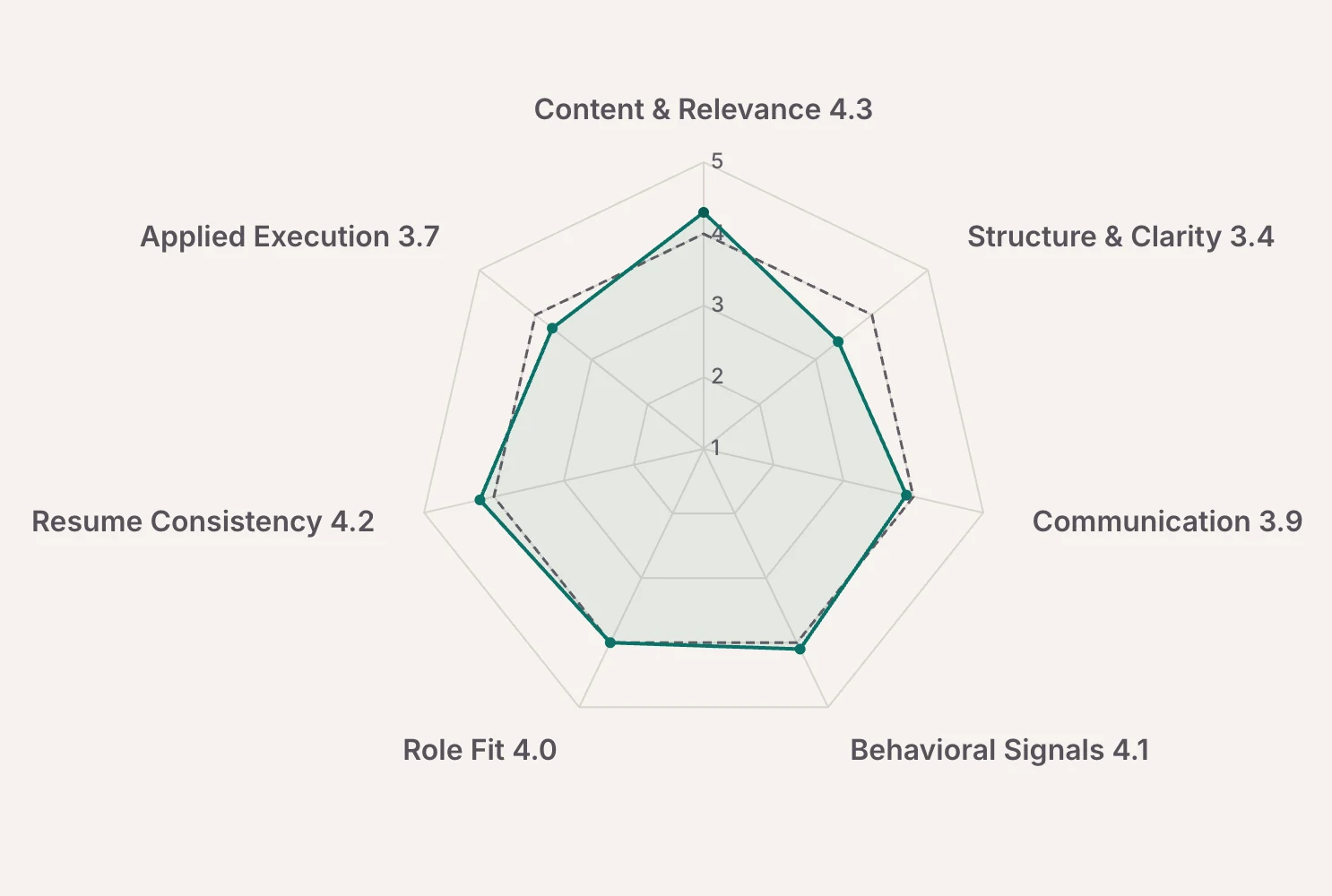
After the interview you get a written report. It scores seven dimensions — content and relevance, structure and clarity, communication, behavioral signals, role-specific fit, consistency with your resume, and applied execution — each 1–5 against a fixed strong-performance bar (4.0), judged against the operations and finance rubric and every score tied to something you said.
Applied execution is the live exercise. When your shared screen could be read, it is scored mainly from the table or calculation you produced; otherwise from how you worked through it out loud.
It closes with the three things to work on first, each drawn from your own answers, and a Mirror Snippet: a short clip of one of your answers, played back with its fillers and pauses.
Common questions
An operations and finance mock interview on InterviewSparrow covers six competencies: modeling rigor, variance analysis storytelling, cross-functional partnership with non-finance teams, audit-trail discipline, forecast honesty, and process improvement instinct.
An operations and finance mock interview includes one exercise in which you work a small calculation or table in any spreadsheet on your shared screen; a manager or leader title gets a spoken scenario instead.
The operations and finance rubric covers operations, finance, FP&A and revenue operations roles, and it is calibrated to the interview bar you pick: Entry-level, Professional or Senior.